Showing posts with label millennials. Show all posts

Thursday, January 11, 2018

How Housing Counseling Creates More Neighborhood Choice for Buyers

by Marietta Rodriguez
NeighborWorks
The US housing system simultaneously is one of the most efficient markets in the world and one of the most complex.

While the efficiency offers consumers many opportunities, the complexity makes it more likely that consumers will make housing and mortgage choices that are not in their best interests. However, our experience at NeighborWorks® shows that housing counseling programs can greatly increase buyers' ability to find and finance homes that are right for them.

With transparent pricing, multiple participants, and regulations that help ensure its stability and strength, the US housing system has many of the attributes of an efficient market. Moreover, as the papers in this panel describe, new technologies are making it even easier to access information about both homes for sale and ways of financing the purchases of those dwellings.


However, many consumers find the home buying process to be daunting. Illustratively, a recent household survey conducted for NeighborWorks® America found 74 percent of Americans (and more than 80 percent of millennials) think that the home buying process is complicated. The survey also found that while the overwhelming share of Americans (including millennials) consider homeownership a key component of the American dream—especially people of color and millennials—thousands of would-be buyers are shut out of the market because of confusion about down payment requirements, lack of information about credit standards, and the burden of student loan debt. Moreover, the complexity of the housing system creates the possibility that consumers who are in the market may make housing and mortgage choices that are not in their best interests, including limiting their home choices without looking at all of the available options and selecting mortgage products that are unsuitable or too expensive.

Part of the problem may be that when seeking information on buying a home, Americans are most likely to consult a real estate agent, search the web, or talk with friends or family who are homeowners. In contrast, only about 40 percent of adults (and half of millennials) are likely to seek counsel from a non-profit organization, such as the many NeighborWorks® member organizations that provide advice on buying a home (and only a fifth said they were very likely to do so).

This is unfortunate because our experience at NeighborWorks® strongly suggests that working with certified housing counselors (at a NeighborWorks® Homeownership Center or other HUD-approved housing counseling agencies) can help consumers make good choices about whether and what to buy, how to finance those purchases, and how to maintain their new homes. Housing counselors do so by working one-on-one with potential homebuyers, helping them develop a budget and to strengthen their credit so they can maximize their chance of getting the lowest possible mortgage rate. Moreover, because they are tightly connected to the communities they serve, housing counselors are aware of  trends practically on a block-by-block basis, knowledge that can help a homebuyer sift through the mountains of data on everything from traffic patterns, crime statistics, and school ratings to which community is closest to the best green space and other amenities.

Housing counselors also can help consumers gain access to a myriad of down payment assistance programs and mortgage products that can make it possible to either spend less than they had planned on mortgage payments or to purchase higher priced homes in more desirable communities. The down payment assistance programs, for example, can not only reduce the time and amount of cash consumers must save on their own to buy a home, they can also reduce the amount they need to borrow, which can lover monthly mortgage payments. Knowing about these programs may be especially important for non-White consumers. According to the 2017 NeighborWorks® America Housing Survey, the average African-American and Hispanic consumer assumed that the minimum down payment generally was a little more than 20 percent, an amount substantially higher than the typical down payment made by first-time homebuyers or the 3.5 percent down payment requirement for an FHA loan.

Moreover, because the role of a housing counselor is to help a homebuyer make the right choice for themselves, a housing counselor is not limited to a small set of mortgage choices the way a mortgage officer at a particular lender would be. For example, the largest mortgage lenders originate very few loan products that are offered by state housing finance agencies (HFAs). These HFA mortgages often have strong, but more flexible underwriting criteria that can help overcome mortgage denial issues that may happen with standard mortgage products and underwriting policies.

Combined, all this assistance can help ensure that homebuyers are more likely to choose affordable homes and mortgages, according to a 2013 study done for NeighborWorks® by Neil Mayer and Associates. The study, which looked at 75,000 homeowners who received housing counseling from NeighborWorks® organizations, found that compared to similar homeowners who did not receive counseling, homeowners who received counseling were one-third less likely to fall seriously behind on their mortgages. Such data, and other findings from the study, confirm that housing counseling allows consumers—particularly low and moderate-income and minority consumers—to access and remain in affordable homes in a wider and more diverse array of neighborhoods and communities.


Papers from the A Shared Future symposium are available on the JCHS website

Friday, June 16, 2017

Growing Demand and Tight Supply are Lifting Home Prices and Rents, Fueling Concerns about Housing Affordability

A decade after the onset of the Great Recession, the national housing market has, by many measures, returned to normal, according to the 2017 State of the Nation’s Housing report, being released today by live webcast from the National League of Cities. Housing demand, home prices, and construction volumes are all on the rise, and the number of distressed homeowners has fallen sharply. However, along with strengthening demand, extremely tight supplies of both for-sale and for-rent homes are pushing up housing costs and adding to ongoing concerns about affordability (map + data tables). At last count in 2015, the report notes, nearly 19 million US households paid more than half of their incomes for housing (map + data tables).

National home prices hit an important milestone in 2016, finally surpassing the pre-recession peak. Drawing on newly available metro-level data, the Harvard researchers found that nominal prices in real prices were up last year in 97 of the nation’s 100 largest metropolitan areas. At the same time, though, the longer-term gains varied widely across the country, with some markets experiencing home price appreciation of more than 50 percent since 2000, while others posted only modest gains or even declines. These differences have added to the already substantial gap between home prices in the nation’s most and least expensive housing markets (map).

“While the recovery in home prices reflects a welcome pickup in demand, it is also being driven by very tight supply,” says Chris Herbert, the Center’s managing director. Even after seven straight years of  construction growth, the US added less new housing over the last decade than in any other ten-year period going back to at least the 1970s. The rebound in single-family construction has been particularly weak. According to Herbert, “Any excess housing that may have been built during the boom years has been absorbed, and a stronger supply response is going to be needed to keep pace with demand—particularly for moderately priced homes.”

Meanwhile, the national homeownership rate appears to be leveling off. Last year’s growth in homeowners was the largest increase since 2006, and early indications are that homebuying activity continued to gain traction in 2017. “Although the homeownership rate did edge down again in 2016, the decline was the smallest in years. We may be finding the bottom,” says Daniel McCue, a senior research associate at the Center.

Affordability is, of course, key. The report finds that, on average, 45 percent of renters in the nation’s metro areas could afford the monthly payments on a median-priced home in their market area. But in several high-cost metros of the Pacific Coast, Florida, and the Northeast, that share is under 25 percent. Among other factors, the future of US homeownership depends on broadening the access to mortgage financing, which remains restricted primarily to those with pristine credit.

Despite a strong rebound in multifamily construction in recent years, the rental vacancy rate hit a 30-year low in 2016. As a result, rent increases continued to outpace inflation in most markets last year. Although rent growth did slow in a few large metros—notably San Francisco and New York—there is little evidence that additions to rental supply are outstripping demand. In contrast, with most new construction at the high end and ongoing losses at the low end (interactive chart), there is a growing mismatch between the rental stock and growing demand from low- and moderate-income households.

Income growth did, however, pick up last year, reducing the number of US households paying more than 30 percent of income for housing—the standard measure of affordability—for the fifth straight year. But coming on the heels of substantial increases during the housing boom and bust, the number of households with housing cost burdens remains much higher today than at the start of last decade. Moreover, almost all of the improvement has been on the owner side. “The problem is most acute for renters. More than 11 million renter households paid more than half their incomes for housing in 2015, leaving little room to pay for life’s other necessities,” says Herbert.

Looking at the decade ahead, the report notes that as the members of the millennial generation move into their late 20s and early 30s, the demand for both rental housing and entry-level homeownership is set to soar. The most racially and ethnically diverse generation in the nation’s history, these young households will propel demand for a broad range of housing in cities, suburbs, and beyond. The baby-boom generation will also continue to play a strong role in housing markets, driving up investment in both existing and new homes to meet their changing needs as they age. “Meeting this growing and diverse demand will require concerted efforts by the public, private, and nonprofit sectors to expand the range of housing options available,” says McCue.


Live Webcast Today @ Noon ET

Tune into today's live webcast from the National League of Cities in Washington, DC, featuring:

Kriston Capps, Staff Writer, CityLab (panel moderator)
Chris Herbert, Managing Director, Joint Center for Housing Studies
Robert C. Kettler, Chairman & CEO, Kettler
Terri Ludwig, President & CEO, Enterprise Community Partners
Mayor Catherine E. Pugh, City of Baltimore, Maryland

Tweet questions & join the conversation on Twitter with #harvardhousingreport

Tuesday, February 28, 2017

New Report: Aging Homeowners Drive Growth in Remodeling as Millennials Begin to Gain Footing

Homeowner spending on remodeling is expected to see healthy growth through 2025, according to Demographic Change and the Remodeling Outlook, the latest biennial report in our Improving America’s Housing series. Demographically based projections suggest that older owners will account for the majority of spending gains over the coming years as they adapt their homes to changing accessibility needs. Although slower to move into homeownership than previous generations, millennials are poised to enter the remodeling market in greater force, buying up older, more affordable homes in need of renovations.

The residential remodeling market includes spending on improvements and repairs by both homeowners and rental property owners, and reached an all-time high of $340 billion in 2015, surpassing the prior peak in 2007. [See our Interactive Infographic.] Spending by owners on improvements is expected to increase 2.0 percent per year on average through 2025 after adjusting for inflation, just below the pace of growth posted over the past two decades, and about on par with expected growth in the broader economy.

The large baby boom generation has led home improvement spending for the past twenty years, and its influence shows no signs of waning. Older homeowners will continue to dominate the remodeling market, as they make investments to age in place safely and comfortably. Expenditures by homeowners age 55 and over are expected to grow by nearly 33 percent by 2025, accounting for more than three-quarters of total gains over the decade. The share of market spending by homeowners age 55 and over is projected to reach 56 percent by 2025, up from only 31 percent in 2005.

Gen-Xers are now in their prime remodeling years, and while some are still recovering from home equity losses after the housing crash, many in this generation will undertake discretionary projects deferred during the downturn. And as younger households move into homeownership, they will supplement the already thriving improvement market.


Try the Interactive Infographic
“With national house prices rising sufficiently to help owners rebuild home equity lost during the downturn, and with both household incomes and existing home sales on the rise, we expect to see continued growth in the home improvement market,” says Kermit Baker, director of the Remodeling Futures Program at the Joint Center for Housing Studies.

Even though increasing house prices are encouraging homeowners to reinvest in their homes, they also are raising housing affordability concerns among younger buyers. Climbing mortgage interest rates and rising house prices not only make homeownership more difficult for younger households, but leave those who are able to buy with fewer resources to make improvements and repairs. And while high rents may provide an incentive to buy homes, they also make it difficult for first-time buyers to save for a downpayment.

Some demographic trends are also presenting challenges to a healthier remodeling market outlook. A disproportionate share of growth over the coming decade will be among older owners, minority owners, and households without young children; groups that traditionally spend less on home improvements.

“Despite these challenges, the remodeling industry should see numerous growth opportunities over the next decade,” says Chris Herbert, managing director of the Joint Center for Housing Studies. “Strong demand for rental housing has opened up that segment to a new wave of capital investment, and the shortage of affordable housing in much of the country makes the stock of older homes an attractive option for buyers willing to in invest in upgrades.”

Finally, as a new generation of homeowners enters the remodeling market, specialty niches focused on energy-efficiency, environmental sustainability, and healthy homes are likely to see significant growth. Home automation—encompassing everything from entertainment systems to home energy management, lighting, appliance control, and security—is also emerging as a strong growth market, particularly among younger households.

Looking ahead, there are several opportunities for further growth in the remodeling industry. The retiring baby boom generation is already boosting demand for accessibility improvements that will enable owners to remain safely in their homes as they age. Additionally, growing environmental awareness holds out promise that sustainable home improvements and energy-efficienct upgrades will continue to be among the fastest growing market segments.


Read the full report, try the Interactive Infographic, or join the conversation on Twitter with 
#HarvardRemodeling.

Thursday, February 16, 2017

Defining the Generations Redux

by George Masnick
Senior Research Fellow
How should we define the baby boom, Generation X, and the millennial generation?

In a Joint Center blog published in 2012, I argued that using 20-year age spans for each generation would make it easier to compare them. Since many researchers still use generational definitions that span different and inconsistent age ranges, particularly for millennials, it is perhaps timely to reframe and restate my case.

In keeping with my recommendations, the Joint Center has long identified the cohort born between 1945 and 1964 as baby boomers.Those born between 1965 and 1984 are Generation X, and the cohort born between 1985 and 2004 are millennials (Figure 1). 

However, other analysts use several different earlier dates to usher in the millennial generation, apparently because they want to ensure that the oldest member of this cohort were considered adults at the dawn of the new millennium (i.e. they had turned 18 or 20 in the year 2000). This definition meant that by 2015, the oldest millennials were in their mid-30s, old enough to prompt compelling stories about how many 30-somethings were still living with parents, living in cities, forsaking marriage and childbearing, and delaying homeownership. In contrast, under my recommended cut-off dates, the oldest millennials turned age 20 in 2005 and didn’t start entering their 30s until 2015.


Besides making it easier to compare generations, there are several reasons why the millennial generation should start with those born in 1985 and turning 20 in 2005. As I noted in my 2012 blog, 1985 was the year that U.S. births once again exceeded 3.7 million, the approximate number that demarcated the beginning and the end of the baby boom, as well as the beginning and the end of the “baby bust” that defines Generation X.

Three other big changes occurred shortly after 2005 that significantly altered the way young adults live. First, social media participation skyrocketed. Facebook became available to everyone age 13 and older with a valid e-mail address in September 2006. Twitter became public in 2006. The first iPhone was released in June of 2007. As a result of these and other changes, the share of adults using social media rose from five percent in 2005 to 69 percent in 2016, according to a recent Pew Research publication.

Second, student loan debt outstanding more than tripled between 2005 and 2016, rising from $400 billion to over $1.3 trillion. This high level of debt is thought to affect everything from leaving the parental home, to getting married and starting a family, and purchasing a first home. 

Third, and perhaps most importantly, the economic changes that led to the Great Recession hit hardest among young adults who were in their 20s shortly after 2005. The unemployment rate of adults older than 25 without a high school degree rose from below six percent in late 2006 to 15 percent in mid-2009. (Those with a high school degree or more followed this trend within a year.) Unemployment rates of those with a high school degree or more have slowly improved, but still remain above pre-recession levels. Unemployment rates for those with less than a high school degree have returned to their pre-recession elevated levels, but people in this group generally are making less money and receiving fewer benefits than they did before the recession. Meanwhile, housing costs have returned to, or now exceed, their pre-recession levels.

Using equally broad 20-year age spans produces several important findings about the different generations. To start with, the millennial generation has been larger than the baby boom generation, now or at any other previous time since the boomers were age 10-29 in 1975 (Figure 2). Millennials now number almost 87 million compared to less than 79 million for baby boomers at the same age. This is in contrast to findings of a 2016 Pew Research study that compared generations using millennials with a smaller age range and found roughly equal numbers between these two generations in 2015 (75 million).


Using consistent age spans also shows the changing ways that immigration has affected the number of people in each generation. In 1995, when Generation X was age 10-29, it was smaller than the baby boom generation was in 1955, when it was the same age. However, because of immigration, by 2005, when Generation X was age 20-39, it already exceeded the number of baby boomers at the same age. 

Immigrants also make up a small but growing share of millennials. In 2015, 9.6 percent of millennials were foreign born compared to 21.4 percent of Generation X, and 15.3 percent of baby boomers (Figure 3). However, according to the latest Census Bureau population projections, the share of millennials who are foreign born is expected to rise to 20.9 percent in 2035 when they are age 30-49, which will boost the number of millennials to 97.3 million (Figure 4).  


* Data do not allow 85-89 year olds from 85+ age group

Finally, the constant-age-span approach allows us to identify significant generational differences in race and ethnicity. Overall, in 2015, 45.4 percent of millennials, 41 percent of Generation X, and 28.6 percent of baby boomers were minorities (i.e. non-Hispanic Blacks, non-Hispanic Asian/Others, or Hispanics of any race). Moreover, because of continued immigration, the share of millennials who are minorities is projected to rise to almost 50 percent in 2035 and the share of Generation X is projected to rise slightly to 42.4 percent. In contrast, the share of baby boomers who are minorities is projected to hold constant at 28.6 percent. 

These differences reflect changes for both foreign-born and native-born members of each generation. In 2015, fully 85 percent of both foreign-born millennials and foreign-born members of Generation X were minorities.  In contrast, only 78.5 percent of foreign-born baby boomers were minorities. Moreover, while 41.2 percent of native-born millennials were minorities, only 29 percent of native-born members of Generation X and 19.6 percent of native-born baby boomers were minorities (Figure 5).

* Data do not allow 85-89 year olds from 85+ age group

Looking forward to 2035, the size of the baby boom cohort will drop to about 60 million people because a growing number of baby boomers will pass away. Many millennials and members of Generation X will want to live in the housing units formerly occupied by those baby boomers. Their ability to do so will not only be shaped by the fundamental economic and social changes discussed above but also by whether the large numbers of racial and ethnic minorities in these two generations will have full access to those housing markets, and with it, the ability to achieve the American dream. 

Tuesday, January 3, 2017

Projection: US Will Add 25 Million Households by 2035

by Dan McCue
Senior Research Associate
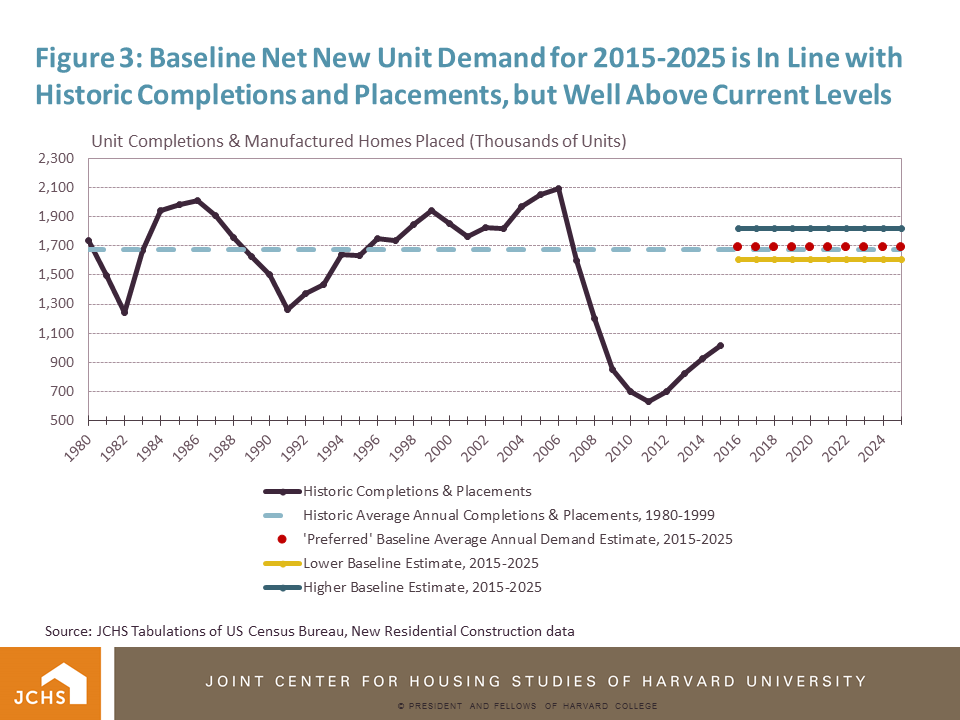
The United States will add 13.6 million households between 2015 and 2025 and another 11.5 million households between 2025 and 2035, according to Updated Household Projections, 2015-2035: Methodology and Results, a new Joint Center working paper. This growth represents an increase from the past decade that is in line with historic rates of growth seen in the 1990s, but still well below the levels experienced in the 1970s (Figure 1). An addendum to the paper indicates that the projected growth in households could lead to continued growth in residential construction activity.

 Click to enlarge
Sources: JCHS Tabulations of US Census Bureau, Housing Vacancy Surveys, Decennial Censuses, and 2016 JCHS Household Projections  

The new household projections incorporate newer population projections from the US Census Bureau that are substantially larger than the Bureau’s 2012 population projections used in our 2013 estimates of household growth, which projected that the U.S. would add 12.4 million households between 2015 and 2025 and 10.35 million households between 2025 and 2035. Our new household projections also make methodological changes related to headship rates—the ratio of households to people—designed to reflect the fact that shifts in headship rates have significantly impacted household growth over the past decade. (As the paper discusses in more detail, rather than continuing the Joint Center's recent practice of holding current headship rates constant, the new estimates use trended headship rates.)

While both changes are significant, the increases from our 2013 household projections are due entirely to the new Census Bureau population projections. In contrast, the methodological changes produce slightly lower projected growth than our previous methodology. However, the methodological changes do affect the distribution of household growth by age, race and ethnicity. In particular, they increase household growth among the oldest age groups and also among non-Hispanic whites between 2015 and 2025. In contrast, they reduce growth among 25-44 year olds as well as from black and Hispanic households.

Despite these shifts, millennials and minority households are still projected to be the main drivers of household growth in coming decades. Indeed, millennials under age of 30 in 2015 are projected to form 23 million net new households between 2015 and 2025, while 72 percent of household growth overall is expected to be non-white households. At the same time, aging of the baby boom generation will bring the number of senior households up to unprecedented heights (Figure 2). Together these forces will reshape housing demand over the next two decades.

 Click to enlarge
Source: 2016 JCHS Household Projections

In addition to the estimates on household growth, the working paper includes an addendum with baseline estimates for the amount of new residential construction that might be needed to accommodate future household growth, as well as the demand for replacement units, second homes, and other changes. Combined, these factors suggest that the baseline demand for new housing units between 2015 and 2025 will range from 16.0 to 18.2 million units. While this estimate is well above most recent rates of new unit completions and mobile home placements, it is consistent with historic averages for past 10-year periods (Figure 3). Although the analysis does not factor in estimates of over- or under- supply, the estimates do suggest underlying demand will support higher construction levels and that the growth in residential construction seen over the past five years is likely to continue.

 Click to enlarge
Source: JCHS Tabulations of US Census Bureau, New Residential Construction data

Thursday, December 1, 2016

Have Recent Demographic Trends Contributed to the Rise and Fall of the Homeownership Rate?

by Jonathan Spader
Senior Research Associate
What has caused the ongoing, decade-long decline in homeownership in the United States? And which factors are most likely to influence homeownership rates in the future?

Discussions of the declining homeownership rate—which fell from 69 percent at its mid-2000s peak to below 64 percent in 2015—frequently point to demographic trends, such as delayed marriage and childbirth, an increasingly diverse U.S. population, and changing attitudes and preferences among both Millennials and retiring baby boomers, as the primary source of the decline. However, non-demographic factors like high foreclosure rates, tightening credit standards, and falling household incomes probably also contributed to the recent declines. To better understand the relative importance of the demographic changes, I used data from the Current Population Survey’s Annual Social and Economic Supplement (CPS/ASEC) for 1985-2015 to examine the extent to which changes in the distribution of U.S. households by age, race/ethnicity, and family type contributed to both the rise and fall in the homeownership rate over the past two decades.

I found that while there have been significant demographic changes in the last 30 years, these changes alone do not explain the last decade’s drop in homeownership rates. Nor do demographic trends explain why the homeownership rate rose from about 64 percent in 1990 to 69 percent in 2005. Rather, changes in the demographic profile of U.S. households suggest that the homeownership rate should have steadily declined by about 1-2 percentage points between 1985 and 2015. This, in turn, suggests that the rise and fall in the homeownership rate between 1985 and 2015 reflects changes in the broader economy, home price appreciation, mortgage credit conditions, and possibly household preferences for owning versus renting that alter the likelihood that demographically-similar households are homeowners.

Several demographic trends are reshaping the profile of U.S. households. First, the aging of the baby boomer generation has increased the number of households in older age cohorts. For example, the number of households headed by an individual age 55-59 hovered near 6.5 million from 1985 to 1995 before increasing to 9.8 million in 2005 and 12.3 million in 2015. (Figure 1) This shift has put upward pressure on the homeownership rate by increasing the number of households in older age cohorts, which have higher homeownership rates than younger age cohorts. (Figure 2) In coming years, the baby boom generation will continue to reshape the profile of U.S. households as they reach the oldest age groups.

 Click to enlarge

 Click to enlarge

Second, the racial and ethnic makeup of U.S. households is changing. The share of white non-Hispanic households declined from 81.3 percent in 1985 to 67.6 percent in 2015. Over the same period, the share of black households increased from 10.8 percent to 12.5 percent, the share of Hispanic households more than doubled from 5.6 percent in 1985 to 13.0 percent in 2015, and the share of Asian and all other households more than tripled from 2.2 percent in 1985 to 6.8 percent in 2015. (Figure 3) The implications of these trends for the homeownership rate depend on whether historical differences in homeownership rates across groups will persist in coming years. Historical CPS data suggest that the Hispanic-White and Asian/Other-White gaps in homeownership rates narrowed only slightly between 1985 and 2015, whereas the Black-White gap increased from 24.6 percentage points in 1985 to 28.8 percentage points in 2015. (Figure 4)

 Click to enlarge

 Click to enlarge

Third, larger numbers of young households are delaying marriage and childbirth until later in life, or forgoing them entirely. The share of households headed by a married couple decreased steadily from 58.9 percent in 1985 to 49.9 percent in 2015. The reduction is due entirely to decreases in the share of married couples with children, as the share of married couples without children remained approximately constant during this period. The decline is offset by increases in the share of single person households, unmarried households with children, and other unmarried households. (Figure 5) While homeownership rates for all groups have declined in recent years, the rates are consistently highest for married couples with children. (Figure 6)

 Click to enlarge

 Click to enlarge

To estimate the cumulative effect of these trends, I conducted shift-share analyses using the CPS/ASEC data. These analyses hold constant homeownership rates at their levels in various years to reveal the extent to which changes in the homeownership rate are driven by changes in the number of households in each age, race/ethnicity, and family type group. For example, using the 1985 sample, I calculated the 1985 homeownership rates associated with each combination of the 13 age groups, 4 racial/ethnic groups, and 5 family type groups shown in the figures above—creating 260 categories in total. For each of the years from 1986-2015, we can then calculate what the U.S. homeownership rate would have been if the homeownership rates for each group remained at the 1985 level. (Readers seeking a more detailed description of the methodology for this analysis can consult a forthcoming JCHS working paper.)

Figure 7 displays the results of such calculations when rates are held constant at their levels in 1985, 1990, 1995, 2000, 2005, 2010, and 2015. The projected homeownership rates suggest that changes in the profile of U.S. households by age, race/ethnicity, and family type do not explain the boom and bust trends in homeownership rates since the early 1990s. Rather, these factors predicted a modest decline in the homeownership rate of about 1-2 percentage points between 1995 and 2015. However, the overall predicted homeownership level varies sharply across the various years, which is the result of unmeasured changes across time in the broader economy, home price appreciation, mortgage credit conditions, and possibly household preferences for owning versus renting that alter the likelihood that demographically-similar households were homeowners in different years.

 Click to enlarge

For a second analysis, I added additional variables to the shift-share analysis using a regression model to calculate the homeownership rates associated with each variable. (Again, more detail about the methodology can be found in the forthcoming working paper.) Specifically, the second analysis adds information on household income, employment status of the head and spouse, educational achievement, veteran status, and more detailed measures of marital status and the presence of children in the household. The projected homeownership rates from this analysis show that while these factors produce more volatile projections, they explain very little of the rise and fall in the actual homeownership rate between 1985 and 2015. The one possible exception is the period from 1996 to 2000, when rising incomes and employment help to explain a portion of the rise in the homeownership rate at that time. However, these factors are not able to explain the continued rise of the homeownership rate following the 2001 recession or the subsequent bust in the latter part of the decade. (Figure 8)

 Click to enlarge

Taken together, these findings suggest that demographic factors explain very little of the rise and fall in the homeownership rate from 1985-2015. Rather, changes in the profile of U.S. households during this period have placed competing pressures on the homeownership rate and largely offset one another. Looking forward, the aging of the baby boom generation and the coming of age of the Millennial generation are similarly unlikely to substantially alter the homeownership rate in the near future. Instead, the trajectory of the homeownership rate depends more heavily on how quickly the foreclosure backlog clears, how many people who lost their homes to foreclosure buy homes in the future, how long mortgage credit conditions remain tight, and whether young households’ slowed rates of homeownership entry persist in future years. Additionally, any major changes in the broader economy, housing finance system, or attitudes toward homeownership may also influence future homeownership rates to the extent that they alter households’ demand or access to homeownership.

Thursday, August 18, 2016

Emerging Consumer Interest in Home Automation

 by Abbe Will
Research Analyst
Home automation is poised for significant growth with the rising prevalence of smartphone use, advancements in wireless technologies, and entrance of the millennial generation—the largest and arguably most tech-savvy generation to date—to the housing and home improvement markets. To better understand this emerging market segment, our Remodeling Futures program is undertaking research to measure the current and future size of this market, investigate the most promising technologies and services for homeowners, identify key players operating in the market, and explain homeowners' perceptions of the benefits and drawbacks to automating their homes.

A first look at homeowner attitudes and behaviors around home automation trends comes from a 2015 consumer survey by The Demand Institute. According to Joint Center tabulations of this survey data, of homeowners who said they were likely to do a home improvement project in the next three years, nearly half expressed excitement to incorporate more “smart home” technology into their homes, and nearly 30 percent reported that they are somewhat or very likely to install home automation products or features. About 29 percent of homeowners likely to remodel placed high importance on their homes having the latest technology, like built-in speakers, remote-controlled thermostats, electronic window coverings, etc. Another 44 percent said having the latest home technologies was somewhat important. Yet only 16 percent said that their current home could be described as already having the latest home automation technologies, which suggests a large gap in current home automation use and interest (Figure 1).

 Click to enlarge
Note: Provided examples of latest home automation technologies included built-in speakers, remote-controlled thermostats and electronic window coverings. Source: JCHS tabulations of The Demand Institute 2015 American Communities Survey: Consumer Interview data

Compared to homeowners who place little or no importance on their home having the latest automation technologies, those who place a lot of importance on home automation are younger, have higher incomes and home values, and live in more urban areas (Figure 2). These homeowners are also much more likely to be planning a home improvement project of any kind in the next three years—68 percent compared to 56 percent of those placing some importance on having the latest home technology and 44 percent for those placing little or no importance. Over half of homeowners who place a high level of importance on having high-tech homes and are likely to remodel in the coming years reported that they are somewhat or very likely to install home automation products or features (52 percent) compared to 28 percent of homeowners expressing some importance and only 10 percent of owners expressing no importance for having an automated home.

 Click to enlarge
Notes: Tabulations are of responses to the following question: How important is it to you that your home has the latest technologies, like built-in speakers, remote-controlled thermostats and electronic window coverings, etc., where 1=not at all important and 10=extremely important? Very important includes rankings of 8-10, not important includes rankings of 1-3.Source: JCHS tabulations of The Demand Institute 2015 American Communities Survey: Consumer Interview data.

There is a dramatic difference in attitudes toward home automation products and services by age of owner. Only 28 percent of homeowners age 65 and over who are likely to remodel in coming years expressed excitement to incorporate “smart home” technologies, compared to over two-thirds of owners under age 35 who either somewhat or strongly agreed with this sentiment. And where only 13 percent of homeowners age 65 and over reported being somewhat or very likely to install home automation products or features in the coming three years, almost 43 percent of owners under age 35 reported the same intent. A slightly higher share of owners age 35-44 expressed likelihood to install home automation improvements at 45 percent, but this share fell sharply for owners age 45-54 (30 percent) and age 55-64 (23 percent).

Although many homeowners are motivated to automate their homes, it is unclear how thoroughly they will act on their enthusiasm. According to a 2015 poll reported by The Demand Institute, homeowners may be hesitant to fully engage in home automation products and features because of high product costs, security flaws and glitches, and concerns for whether smart products will function as well as traditional home products. More research on the emerging home automation market will be shared in the forthcoming 2017 Improving America’s Housing report.

Monday, June 20, 2016

Increased Living with Parents among 18-34 Year Olds and the Implications for Future Housing Demand

by Daniel McCue
Senior Research Associate
The rise in the number and share of adults living with their parents is a well-documented trend that became increasingly apparent after the Great Recession.  It is also increasingly meaningful to housing markets as household growth slowed markedly in this period, largely as a result of fewer young adults forming households. And it is a trend that is ongoing. A report issued by the Pew Research Center found that for the first time in the modern era a higher share of adults age 18-34 are living with parents than living with partners or spouses.

In light of this information, one might conclude that as long as the rate of young adults living with their parents remains high, household growth will continue to be depressed. But even as the rate of adults living with parents continues to grow, the Census Bureau’s Housing Vacancy Survey also reported that household growth again increased in 2015 and has been accelerating since 2012.  If young adults―who are responsible for the majority of new household formation―are still living with parents at ever higher rates, how is it that household growth is picking up?  The answer lies in the shifting age distribution of millennials, who have now begun to exit the time of life where living with parents is most common and enter older ages where living with parents is less common.  With this shift, we can maintain today’s higher levels of living with parents among young adults and still have an acceleration of household growth.     

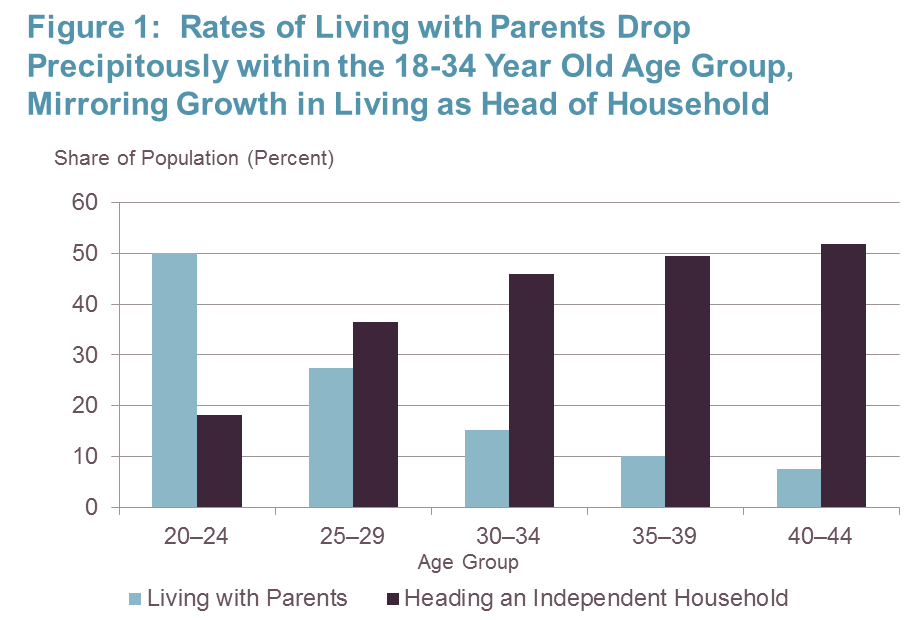
The 18-34 year old age group is also a very wide grouping for looking at living with parents, as the rate drops sharply across these ages.  Rates start at 50 percent among adults age 20-24 and drop down to 15 percent for adults age 30-34 (Figure 1).  This pattern basically mirrors the growth in headship rates (rates of being the head of an independent household) that rise most steeply for adults in their 20s. 

Source: JCHS tabulations of US Census Bureau, 2014 American Community Survey 1-Year Estimates.

In addition to being higher, rates of living with parents have also increased much more for the younger set of adults aged 18-34 (Figure 2).  According to tabs of the ACS, rates of living with parents in 2008-2014 grew most for 20-24 and 25-29 year olds, each up by roughly 6 percentage points.  Increases taper off with age from there, dropping to 4 percentage points for those age 30-34 and 2.5 percentage points for the age 35-39 year old age group.  Similarly, household headship rates dropped most for the younger age groups under age 30 and less for those older than age 30.

Source: JCHS tabulations of US Census Bureau, 2014 American Community Survey 1-Year Estimates.

Meanwhile, over the past decade the majority of population growth for young adults was skewed towards the younger side of this 18-34 year old group as the millennials replaced the smaller, generation-X population in the 20-24 and 25-29 year old age groups.  In addition to being the ages where rates of living with parents are highest, the sharp increases in living with parents that occurred among these age groups has meant that far fewer households were formed compared to what would have been expected given the magnitude of population growth.  Tabulations from the CPS show that declines in headship rates over 2005-2015 for the 15-19, 20-24, and 25-29 year old age groups reduced household growth by 1.7 million below what would have occurred under constant rates. 

Over the next 10 years, the aging of the millennial generation will shift the bulk of population growth from the 20-24 and 25-29 year old age groups to the 30-34, 35-39, and 40-44 year old age groups (Figure 3).  At these older age groups, changes in rates of living with parents and overall household headship have been much more moderate and remain closer to recent historical levels. 

Source: JCHS tabulations of US Census Bureau, United States Population Estimates and 2014 Population Projections.

This all suggests that future expected population growth in the 30-44 year old age groups will translate more directly into household growth over the next decade, even if living with parents continues to remain high for 20-somethings.  The pick-up in annual household growth levels since 2012 as reported by the Housing Vacancy Survey is a sign that this has begun.


Friday, March 18, 2016

Millennial Housing Issues in Perspective: Visualizing Cohort Trends in Population Size, Household Numbers, Ownership and Renting

George Masnick
Senior Research Fellow
Today’s 41 million young adults age 25-34 have been slow to move into independent household formation and homeownership. Exactly how slowly and why, and what the future likely holds for these individuals over the next decade, is the subject of much debate. The magnitude of delayed household formation and homeownership can perhaps be better appreciated if we directly compare this young cohort of adults with the cohorts that preceded them in the age structure. The four figures below track the different cohorts’ trends between 2003 and 2013 in population size, total households, owner households and renter households as measured by the American Housing Survey.

Population Size

Figure 1 shows population size of five different 10-year birth cohorts. The youngest cohort (born 1979-1988) remained fairly constant in size between 2003 and 2013 at about 41 million. This number is slightly larger than the next oldest cohort (born 1969-1978), but not as big as the cohort born 1959-1968, which includes younger baby boomers.


The cohorts born from 1959-1968 and 1969-1978 increased slightly in size over the 2003-2013 period due to migration from abroad, underscoring the fact that cohort size among young and middle-age adults can still grow as we go forward. Why the 1979-1988 birth cohort did not also increase in size between 2003 and 2013 (it actually declined by about 300,000) is likely due to the effects of the Great Recession having had a bigger impact on 25-34 year-old immigration. The growth in the total number of annual undocumented immigrants actually turned negative during this period, and slow job growth in construction and manufacturing also had a large impact on slowing overall immigration into the under 35 age groups.

U.S. immigration law still promotes family re-unification as one of its core principles, and this provision was less impacted by the economic downturn than employment driven immigration, and probably resulted in a more sustained immigration of 35-44 and 45-54 year olds. In addition, undocumented immigrants in these age groups were more likely to have lived here longer and have children born in the U.S., so they were less likely to have left the country during the Great Recession.

From 2003-2013, the two oldest cohorts between age 55-64 and 65-74 lost population due to mortality. The oldest (born 1939-1948) declined by 22 percent and the next oldest (born 1949-1958) lost 11 percent of its population.

Number of Households

Figure 2 shows parallel cohort trends in the number of households produced by the population in Figure 1. Three things are noteworthy. First, most of a cohort’s contribution to household growth occurs as it moves from age group 15-24 to 25-34, as is visible in the sharp upturn in households among the leftmost (youngest) cohort in Figure 2. Second, the cohort born 1969-1978 (red line) appears to have formed fewer households in 2013 at age 35-44 relative to older baby boomers at the same age than its population size might have predicted. The 1969-1978 cohort is not on track to attain the household numbers achieved by the 1959-1968 and 1949-1958 cohorts (green and purple lines). Third, the two oldest cohorts, although having lost a significant share of their populations from mortality, did not reduce their household numbers proportionally.

Lower levels of household formation in the youngest two cohorts when compared to baby boomers are somewhat expected because they contain higher shares of both foreign born and minority native born, each of which have lower rates of forming independent households. They are also cohorts that have experienced delayed marriage and fertility among the native-born non-minority population, making independent household formation for the youngest members of the cohort as a whole even less likely. But if members of these cohorts are simply postponing marriage and family formation, household formation for many is also being postponed, so future upward movement in household trajectories when cohorts are still under age 45 is likely.

The fact that household numbers after age 55 do not drop as quickly as population numbers is because married couples head most households in older age groups, and if one spouse dies, the household generally survives. In addition, divorce in middle and old age generally turns one household into two, partly offsetting deaths that occur to persons who live alone. After age 75, losses from mortality increase dramatically, so it will not be until after 2020 for the oldest baby boomers, and after 2030 for the youngest and largest baby boomer cohort that significant declines in older owner households take place.

Owner and Renter Household Trends

Decomposing the cohort trends in total household numbers into owners and renters further refines our understanding of the demographic underpinnings of recent household and housing market dynamics. The youngest cohort’s shortfall in household formation, as it moved into the 25-34 age group, was especially severe on the owner side, as shown in Figure 3.


In spite of having a noticeably larger population at age 25-34 compared to the next oldest cohort (red line), and a slightly larger number of total households at the same age, owner households were almost a million fewer. In addition, this next oldest cohort also shows levels of owner household formation well below what was achieved by the cohort born 1959-1968 (green line) when it was age 35-44 in 2003. Finally, the 1959-1968 cohort had slightly fewer owners in 2013 than the next oldest cohort (purple line) at age 45-54 despite having both 4+ million more people and 1.2 million more total households. But we must not lose sight of the fact that the older 1959-1968 and 1949-1958 cohorts aged into their 40s and 50s during a very different economic period (1993-2003) with better income growth, looser mortgage lending standards and more affordable newly built housing. The number of owner households that these older cohorts achieved at ages 25-34, 35-44, and 45-54 might not be a proper benchmark by which to judge the progress of today’s younger cohorts.

Figure 4 shows that in 2013, the number of renters in the youngest cohort at age 25-34 was significantly larger than the number of owners (11 million compared to 8 million). This compares to much greater parity between the number of owners and renters in the next oldest cohort when it was age 25-34. Although the number of owners in the youngest cohort was well below the number of renters in 2013, the increase in owners between 2003 and 2013 was still larger than the increase in renters.

Looking forward, the 1979-1988 cohort is going to add many more owners over the next 10 years, while at the same time its number of renters should decline when the cohort moves between ages 25-34 and 35-44, given historical cohort transitions. In fact, this youngest cohort should continue to add owners and lose renters over the next three decades until it reaches ages 55-64. Of course, the exact numbers of owner additions will be determined by the state of the economy, by income trends, by housing prices and mortgage interest rates, and by lending practices of banks and mortgage companies. To a certain extent, future homeowner numbers will also be determined by future demographic trends in marriage, fertility, immigration and mortality that affect this age group, but these are less likely to involve significant departures from recent historical levels and are more predictable.

By examining the cohort trends in the numbers of population, households, owners and renters in the way we have, we gain a greater appreciation of the degree to which millennials have been slow to form owner households. But we also find that the next older cohort, born 1969-1978, is also well below levels achieved by baby boomers when they were the same ages. There remains room for much upward movement in owner household formation for these two youngest cohorts. However, it is unlikely that these cohorts will ever reach the 16 million owner households achieved by each 10-year baby boomer cohort without significant reductions in the obstacles they now face in becoming and remaining homeowners. Still, we should look forward to continued gains in owner household formation for the two youngest cohorts as they move into their 40s and 50s over the next decade and beyond.

Wednesday, January 27, 2016

Article review- “Patriarchy, Power, and Pay: The Transformation of American Families, 1800-2015”

George Masnick
Senior Research Fellow
At my age, there is little that makes my jaw drop, especially while reading an article in one of my professional journals. However, this is exactly what happened when “Patriarchy, Power, and Pay: The Transformation of American Families, 1800-2015” by Steven Ruggles appeared in the latest issue of Demography. (Another almost identical version of this paper is available free of charge here.) What struck me as amazing is the way Ruggles provides a long-term perspective on many of the demographic and economic trends taking place today that I have studied using a much shorter time frame. And by long-term, we are talking 150-200 years!

The Joint Center for Housing Studies' early effort to describe changes in household structure and the labor force participation of American womenThe Nation's Families, 1960-1990– adopted a temporal perspective from 1960-1990. Published in 1980, we thought at the time that a three-decade perspective was all that was needed to understand the dramatic changes of that era. Wrong! The longer historical perspective sheds much more light on the origins of today’s demographic shifts, particularly in household structure, and what they might mean for housing.

Ruggles begins with the trend in the share of persons age 65+ who live in multi-generational families. We have noted the increase in this household type during the past two decades, primarily due to the increasing share of Hispanic and Asian immigrants for whom multi-generational residence is more common, and have speculated about its implications for housing consumption. But since we housing researchers rarely look at trends spanning more than 30 or 40 years, we have no sense of whether the upward trend in multi-generational living is indeed all that significant.

Ruggles’ Figure 1, reproduced below, shows how slight the recent turnaround has been relative to longer-term historical levels. The high share of the labor force based in an agricultural economy drove the very high historical incidence of older Americans living in multi-generational households. Three quarters of the labor force in 1800 worked in agriculture, and farm labor still was in the majority in 1850 when the share of 65+ living in multi-generational families was also 75 percent. Ruggles explains convincingly why an agricultural based economy tied the generations together, and why the rise of wage labor off the farm split them apart.


Ruggles’ main theme is that the decline of what he calls the “corporate family” – those working in agriculture and other (often related) family businesses – and the gradual transformation of the workforce to include first only male breadwinners, and later dual earner and female breadwinner households – had the effect of making household structures both simpler and more fluid. Once again, his long-term perspective is enlightening in looking at the recent trend in such things as delayed marriage and divorce. Age at first marriage for both men and women has been rising steadily since 1960, and he predicts that the share of never-married 40-44 year old women will almost double in the near future, rising from 15 percent in 2010 to about 28 percent in 2030. Similarly, the rate at which married women are divorcing has increased steadily since 1960, showing no sign of this trend slowing. Consequently, the share of all households without a married couple present – which held near 20 percent between 1850 and 1950 – has risen to over 50 percent in 2010, and continues its upward trajectory.

Nor is it simply the case that young adults are just trading marriage for cohabitation. To be sure, this is happening to some degree, but Ruggles notes that the share of 25-29 year olds without a co-residing partner has grown from 23 percent in 1970 to 48 percent in 2007 to 54 percent today. The fastest growing household type is single-person rather than cohabiting couples, as more and more adults of all ages who never married, are separated/divorced, and are widowed live alone.

If the household is the unit of both production and consumption, greater fragmentation and instability in household structures is troublesome. The primary household production good today is the next generation, and the U.S. appears to be following the lead of many European countries in developing fertility levels below replacement. Nothing that Ruggles presents in his paper provides comfort that the recent declining fertility rates are simply due to the lingering effects of the Great Recession and will likely reverse themselves.

One contributing factor to declining fertility may be trends in income. Households have always provided the mechanism for combining incomes. To Ruggles’ dismay, the evolving global economy is leaving more American households without secure incomes. The long slide in the relative earning power of young men over the past 40 years has been mitigated by the steady rise in employment of wives. But now that fewer and fewer households contain a married couple, and given that women’s real wages have also begun to decline, aggregate household incomes for married couples has begun to decline as well. Ruggles suggests that the largest source of decline in economic opportunity for young people, especially over the past two decades and in future decades, may be the automation of both manufacturing and services made possible by new technologies.

Housing consumption broadly should follow the downward trends in employment and income. Boosting household formation and homeownership rates, especially among the young, will require a reversal of many of the long-term demographic and economic trends that Ruggles discusses.

Ruggles’ article has sixteen figures, some only going back in time to 1940, but many spanning 150 or more years. I highly recommend you take a look. Some will surely make your jaw drop too.

Tuesday, December 15, 2015

Look Who’s Renting: The People Behind the Recent Surge in Demand for Rental Housing

Dan McCue
Senior Research
Associate 
One of the major trends highlighted in the Joint Center’s recently released report America’s Rental Housing 2015 is the unprecedented growth in the number of renter households over the past 10 years.  The numbers are dramatic no matter how you slice them, leading to an impressive list of facts: we’ve been adding nearly a million renter households a year for almost a decade; the number of renters has grown by fully 25 percent in the past 10 years; there are nearly 9 million more renter households in 2015 than there were in 2005; and in the past ten years we have seen the largest increase in renters of any 10-year period in history on records dating back to the 1960s. This sharp growth in demand has been the primary force behind the widespread tightness in rental markets that has driven vacancies down and rents up for millions of Americans as supply works to respond.  And supply is responding with more multifamily construction currently under way than in any time in the past 30 years.

 Click to enlarge

So who are all the renters behind this recent growth?  The answer may be somewhat surprising, particularly in terms of the age breakdown.  One might imagine that since renters tend to be younger (with a median age of 40 years versus 55 for homeowners), the majority of recent growth would have been from millions of young millennials piling into rentals in high numbers.  It turns out, however that while the millennial generation (born 1985-2004) is indeed the largest in history in terms of population, they are only responsible for a relatively small portion of the growth in rental population over the last 10 years, approximately 11 percent.  In contrast, well over half of the growth in renters (55 percent) – fully 4 million households– was from people aged 50 and over.  Generation-X-ers (born 1965-1984) in the 30-49 year old age group were responsible for 34 percent of all renter household growth since 2005.

As shown by figure 2, much of the growth in the number of renters age 50 and over reflects a boost in population due to the baby boom generation, who are currently age 50-69 and now entirely in this 50+ age group.   However, only about half of the growth in renters over age 50 resulted from population growth.  The other half of growth was due to householders being more likely to rent than in past years.

 Click to enlarge

Figure 2 also shows how the increased rate of renting among gen-Xers was the entire source of growth in the number of renters aged 30-49 year old.  That the number of renters in this age group grew at all over the past 10 years was impressive given that the total number of households in that age group (owners and renters combined) actually declined during this period.  Indeed, at a stage of life where first time homebuying typically occurs, rentership rates for this generation have not fallen off with age like those of previous generations.  Renters are sitting tight, moving less, and making fewer units available for Millenials to enter the rental market. 

In addition to the age breakdown, the incomes of new renter households may also be surprising.  Again, while renters as a group still tend to have lower incomes relative to owners (median income of $34,000 versus $65,000 for owners), the fastest rates of growth over the past ten years has been in high-income renters (Figure 3).  The number of renters in the top 10 percent highest income bracket grew by 61 percent, more than double the pace of overall growth in renters.

 Click to enlarge

Growth in renter households has extended beyond single-person and unrelated roommate households to encompass all types of living arrangements, including those more commonly associated with homeownership (Figure 4).  Families with children made up a quarter of all growth in renters in 2005-2015, roughly evenly split between couples and single parents.

 Click to enlarge
Additionally, with the resurgence in the number of white, non-Hispanic renter households (who made up one-third of renter household growth in 2005-2015), renter growth was split more evenly across races and ethnicities than in the 1990s and early 2000s when the number of white renters was on the decline.  But minority households continued to be a large part of renter growth, as have immigrant households, with foreign-born renters making up fully 26 percent of growth, even with the post-recession slowdown in immigration.

 Click to enlarge

In sum, the wide-ranging surge in rental demand underscores the fact that rental housing remains an important and necessary housing option for people of all races, incomes, and living arrangements, and one that is becoming an increasingly popular housing choice at all stages of life.  The diversity of the population demanding rentals also necessitates a broad range of rental housing options—with an array of types, styles, sizes, amenities, rent levels, and locations—to meet the needs of renters today and in the future.