Showing posts with label remodeling. Show all posts

Thursday, April 19, 2018

Home Remodeling Expected to Remain Strong and Steady into 2019

by Abbe Will
Associate Project Director,
Remodeling Futures
The robust pace of spending on home renovations and repairs is expected to stay strong over the coming quarters, according to our latest Leading Indicator of Remodeling Activity (LIRA). The LIRA projects that annual growth in homeowner remodeling expenditure will remain above 7 percent throughout the year and into the first quarter of 2019.

Strengthening employment conditions and rising home values are encouraging homeowners to make greater investments in their homes. Upward trends in retail sales of building materials and the growing number of remodeling permits indicate that homeowners are doing more—and larger—improvement projects.

While the overall outlook is positive, one area of concern is the slowing growth in sales of existing homes, since sales traditionally trigger significant renovation spending by both sellers and buyers. Even with this headwind, annual spending on residential improvements and repairs by homeowners is set to exceed $340 billion by early next year.


For more information about the LIRA, including how it is calculated, visit the JCHS website.

Thursday, January 18, 2018

Remodeling Market to March Higher in 2018

by Abbe Will
Research Associate
The coming year is expected to be another robust one for residential renovations and repairs with growth accelerating as the year progresses, according to our latest Leading Indicator of Remodeling Activity (LIRA). The LIRA projects that homeowner spending on improvements and repairs will approach $340 billion in 2018, an increase of 7.5 percent from estimated 2017 spending.

Steady gains in the broader economy, and in home sales and prices, are supporting growing demand for home improvements. We expect the remodeling market will also get a boost this year from ongoing restoration efforts in many areas of the country impacted by last year’s record-setting natural disasters.

Despite continuing challenges of low for-sale housing inventories and contractor labor availability, 2018 could post the strongest gains for home remodeling in more than a decadeAnnual growth rates have not exceeded 6.8 percent since early 2007, before the Great Recession hit.

For more information about the LIRA, including how it is calculated, visit the JCHS website.

Thursday, November 30, 2017

Rebuilding from 2017's Natural Disasters: When, For What, and How Much?

by Kermit Baker and
Alexander Hermann
The bulk of repairs to homes damaged by this year's record-setting disasters will not be done until 2019 or 2020, according to our analysis of post-disaster spending between 1994 and 2015. The analysis, which looked at the estimated annual cost of natural disasters alongside annual estimates of disaster-related home repairs and improvements, suggests that an increase of $10 billion in total disaster losses any time in the previous three years is associated with about $300 million in additional annual spending on disaster-related home repairs and improvements.

Notes: Dollar values are adjusted for inflation using the CPI-U for all items. Natural disaster costs include only natural disasters that generate over $1 billion in damages after adjusting for inflation.
Sources: JCHS tabulation of US Housing and Urban Development, American Housing Survey, and National Oceanic and Atmospheric Administration data.


The finding is significant because 2017 was an unusually destructive year. While inflation-adjusted, disaster-related damages averaged about $40 billion a year between 1994 and 2015, Hurricanes Harvey, Irma, and Maria together caused about $150 billion in damages, according to estimates from CoreLogic and Moody’s Analytics (Figure 1). Moreover, damages from 2017’s winter storms, droughts, and wildfires will push these numbers even higher. In fact, the total cost of 2017’s disasters could exceed damages from any year in the last two decades, including 2005, the previous record year, when Hurricanes Katrina and Rita (and a host of smaller but significant disasters) combined to cause more than $200 billion in damages (in inflation-adjusted dollars).

As in other years that were marked by particularly destructive storms and other disasters, this year’s damages should lead to a spurt in construction activity. Some of it will be construction of and renovations to infrastructure and commercial buildings. Some will be the construction of new single-family homes and multifamily housing units. And some will be disaster-related repairs and improvements to both owner-occupied and rental housing.

Extensive flooding from Hurricane Harvey in Port Arthur, Texas.

To estimate how much will be spent on post-disaster home repairs, and when that spending is likely to occur, we combined information on disaster-related damages reported by the National Oceanic and Atmospheric Administration (NOAA) with data on disaster-related home repairs and improvements for the same years found in the U.S. Census Bureau’s American Housing Survey (AHS). The AHS, as a survey of households, only asks owners to report spending on their homes. The comparison suggests that renovation spending continues to increase for about two to three years after the natural disaster occurs, and that an increase of $10 billion in disaster losses any time over the prior three years generates about $300 million in additional disaster-related home improvement spending during the year studied. If this pattern holds, the bulk of the spending from 2017 losses won’t occur until 2019 or 2020. But when it occurs, there is likely to be a substantial increase in spending on home renovations in those years.

While the delay between disaster losses and repair expenditures may seem unusually lengthy, it is consistent with a study funded by the U.S. Department of Housing and Urban Development (HUD) that examined the rebuilding that took place following Hurricanes Katrina and Rita. In a recent Joint Center blog on that study’s implications, our colleague Jonathan Spader (who worked on the initial HUD study) reported that only 70 percent of hurricane-damaged properties in Louisiana and Mississippi had been rebuilt by early 2010, five years after the storms. The study further found that 74 percent of owner-occupied homes had been rebuilt, compared to only 60 percent of the rental properties.

The delays are due to many factors. Insurance companies need to assess the extent of the damage and determine how much is covered. Home improvement contractors, stretched to the limit and suffering from a labor squeeze, must delay certain projects. Owners have to consider local housing and labor market conditions to determine if repairs or improvements make financial sense. Often, federal, state, and local government entities may slow down rebuilding while they decide whether it’s feasible and, if so, whether building codes and insurance guidelines should be more stringent.

Nevertheless, spending will occur and, when it does, it can be substantial. Illustratively, in 2015 (which came after a few relatively mild years for disasters) spending on disaster-related home renovations accounted for almost $11 billion of the $220 billion spent nationally improving owner-occupied homes according to the 2015 AHS. (Lightning and fires accounted for $2.4 billion of this spending, floods for $2.0 billion, and tornados and hurricanes for $1.6 billion. Winter storms, thunderstorms, earthquakes, and drought accounted for the remainder.)

In short, 2017’s hurricanes and other disasters are likely to result in substantial spending on rebuilding, repairs, and improvements to disaster-damaged homes. Moreover, while that spending will ramp up slowly, it is likely to stretch into next decade.

Thursday, October 19, 2017

Growing Momentum Expected for Remodeling Spending

by Abbe Will
Research Associate
Accelerating growth in residential improvement and repair expenditures is anticipated through the third quarter of 2018, according to our latest Leading Indicator of Remodeling Activity (LIRA).The LIRA projects that annual gains in home renovation and repair spending will increase from 6.3 percent in the fourth quarter of 2017 to 7.7 percent by the third quarter of next year.

Recent strengthening of the US economy, tight for-sale housing inventories, and healthy home equity gains are all working to boost home improvement activity. Over the coming year, owners are projected to spend in excess of $330 billion on home upgrades and replacements, as well as routine maintenance.

And while it’s too early for our LIRA model to capture the effects of recent hurricanes and other natural disasters experienced around the country, there is certainly potential for even stronger growth in remodeling next year as major reconstruction and repairs get underway in affected regions.


For more information about the LIRA, including how it is calculated, visit the JCHS website.

Monday, August 7, 2017

Significant Improvements in Energy Efficiency Characteristics of the US Housing Stock

by Elizabeth
La Jeunesse

Research Analyst
Compared to 2009, single-family homes built before 1980 are now better insulated, have relatively newer heating equipment, and are more likely to have undergone an energy audit. These and other energy-related characteristics of the owner-occupied stock, shown in Table 1, are consistent with the expanding size of the home improvement industry over the past few years, with particular growth in energy-sensitive projects. Homeowners' annual spending for related projects—including roofing, siding, windows/doors, insulation and HVAC—expanded from $50 billion to nearly $70 billion over 2009-2015.


The transformation of the existing US housing stock toward greater energy efficiency also reflects a wave of energy-related incentives for HVAC and building envelope upgrades put in place following the rise of energy prices in the mid-2000s. At the federal level, one of the biggest initiatives was the Obama administration’s American Recovery and Reinvestment Act of 2009, which extended and strengthened tax credits for energy improvements to existing homes, including insulation, windows, roofs, water heaters, furnaces, boilers, heat pumps, and central air conditioners.

Despite recent progress, there is room for growth. As of 2015, 17 percent of single-family homes built prior to 1980 were still reported to have ‘poor insulation’, and only 11 percent had received an energy audit. By comparison, a recent profile of newly constructed homes (built after 2009) showed only 1 percent of residents reporting ‘poor insulation’—an impressively low share. Moreover, nearly 90 percent of new homes come with double- or triple-pane windows. Bringing older homes up to this higher standard will require significant investments to the existing stock.
At the same time, only 5 percent of new homes have smart thermostats—a relatively inexpensive but potentially high-payoff upgrade—and a similar share have energy-saving tankless water heaters. These lower shares suggest room for growth in energy-efficient technologies in new and old homes alike.
Renewable technologies, particularly solar energy, are also showing signs of growth. As of 2015, nearly 6 percent of recently built homes reported on-site solar generation, a relatively small share, but nearly triple the incidence in older homes. Thanks to the Consolidated Appropriations Act of 2016, US taxpayers can still claim a credit of up to 30 percent of expenditures for photovoltaic and solar thermal technologies placed in service in their homes. Several US states also now provide consumers with credits for net excess energy generation, further increasing the payoff for installing renewable energy systems.
With recent declines in energy prices, however, there is some question of whether homeowners still have strong incentives to pursue energy-efficiency improvements. Since 2015, the consumer price index for energy has hovered around 10 percent below its average for the prior ten years (2005-2014). If this trend continues, further progress in energy-related improvements will probably depend even more on consumer preferences and finances, in addition to changing building and product codes, and evolving industry standards. 
Data used in this analysis comes from a newly released 2015 Energy Information Administration survey that tracks the energy-related characteristics of all US residential units. Further results detailing energy consumption intensity (or usage per square foot) will be released in 2018, enabling deeper analysis into the evolution of energy efficiency in US homes.

Thursday, July 20, 2017

Steady Gains in Remodeling Activity Moving into 2018

by Abbe Will
Research Associate
Healthy and stable growth in home improvement and repair spending is anticipated for the remainder of the year and into the first half of 2018, according to our latest Leading Indicator of Remodeling Activity (LIRA), released today. The LIRA projects that annual increases in remodeling expenditures will soften somewhat moving forward, but still remain at or above 6.0 percent through the second quarter of 2018.

The remodeling market continues to benefit from a stronger housing market and, in particular, solid gains in house prices, which are encouraging owners to make larger investments in their homes. Yet, weak gains in home sales activity due to tight inventories in many parts of the country is constraining opportunities for more robust remodeling growth given that significant investments often occur around the time of a sale.

Even with some easing this year, the remodeling market is still expected to grow above its long-term averageOver the coming 12 months, national spending on improvements and repairs to the owner-occupied housing stock is projected to reach fully $324 billion.


For more information about the LIRA, including how it is calculated, visit the JCHS website.

Wednesday, March 15, 2017

Remodeling Activity Projected to Grow in Most Metropolitan Areas

by Elizabeth La Jeunesse
Research Analyst
Spending on home improvements is expected to increase this year in 43 of the nation’s 50 largest metropolitan areas, according to our latest report about the home improvement industry, Demographic Change and the Remodeling Outlook. The report projects that, on average, home improvement spending in 2017 in these metro areas will be 6.8 percent higher than it was in 2016, slightly more than the projected 6.1 increase nationwide. 

However, as an interactive map released in conjunction with the report shows, the growth rates will vary widely. About a third of major metro areas are expected to see strong growth of 10 percent or more, while a similar number should see declines or slow growth of under 3 percent.


Some of the largest increases, in percentage terms, are expected to occur in several Midwestern metropolitan areas such as Cincinnati, Cleveland, Columbus, Kansas City, Minneapolis, and Milwaukee, where there is a consistent demand for housing and prices are not as high as in other parts of the country.

Double-digit gains in home improvement expenditures are also expected in New England’s three largest metro areas—Boston, Hartford, and Providence—where home sales have been strong. While average per-owner spending in other metropolitan areas on the East Coast has been relatively high in recent years, total spending in several of those areas is expected to increase slowly in the next year. The report projects that spending will grow by less than one percent in New York, the nation’s largest metro area, and by less than four percent in the Washington, DC area.

Home improvement spending is also expected to pick up significantly in several fast-growing, Southern metropolitan areas where homebuilding activity has revived and more households are forming, such as Atlanta, Charlotte, Jacksonville, and Orlando. In contrast, spending will grow modestly or may even decline in Southern metro areas with oil-dependent economies such as Dallas, Houston, and Oklahoma City.

On the West Coast, the report projects a significant increase in spending on home improvements in the Sacramento metro area, where house prices recovered more slowly from the Great Recession than in other parts of the state. In contrast, spending is expected to increase only modestly or decline slightly in the Los Angeles, San Diego, San Francisco, and San Jose, where leading indicators suggest housing markets may be approaching their cyclical peaks. In metro areas across the Mountain and Pacific Northwest regions, growth rates are also expected to vary widely, from a low of just under 2 percent in the Las Vegas metro to a high of nearly 10 percent in the Salt Lake City area.

These projections are based on two measures of housing demand—single-family starts and growth in existing home sales—that are strong leading indicators of national remodeling activity. The results broadly support our expectation that home improvement expenditures in certain high-cost markets may soon reach a cyclical peak, while spending will increase in markets where house prices are lower but are increasing steadily.

The report also finds that the national market for home improvements is somewhat more concentrated in the nation’s 15 largest metropolitan areas, which account for about 29 percent of the nation’s homeowners. Illustratively, according to estimates from the 2015 American Housing Survey, average per-owner improvement spending in the same 15 metro areas was $3,500, or more than 30 percent greater than average spending by homeowners outside of these areas. As a result, aggregate spending by homeowners in the same 15 areas totaled over $80 billion, or nearly 37 percent of the total spending by all owners on home improvements nationally.

Tuesday, February 28, 2017

New Report: Aging Homeowners Drive Growth in Remodeling as Millennials Begin to Gain Footing

Homeowner spending on remodeling is expected to see healthy growth through 2025, according to Demographic Change and the Remodeling Outlook, the latest biennial report in our Improving America’s Housing series. Demographically based projections suggest that older owners will account for the majority of spending gains over the coming years as they adapt their homes to changing accessibility needs. Although slower to move into homeownership than previous generations, millennials are poised to enter the remodeling market in greater force, buying up older, more affordable homes in need of renovations.

The residential remodeling market includes spending on improvements and repairs by both homeowners and rental property owners, and reached an all-time high of $340 billion in 2015, surpassing the prior peak in 2007. [See our Interactive Infographic.] Spending by owners on improvements is expected to increase 2.0 percent per year on average through 2025 after adjusting for inflation, just below the pace of growth posted over the past two decades, and about on par with expected growth in the broader economy.

The large baby boom generation has led home improvement spending for the past twenty years, and its influence shows no signs of waning. Older homeowners will continue to dominate the remodeling market, as they make investments to age in place safely and comfortably. Expenditures by homeowners age 55 and over are expected to grow by nearly 33 percent by 2025, accounting for more than three-quarters of total gains over the decade. The share of market spending by homeowners age 55 and over is projected to reach 56 percent by 2025, up from only 31 percent in 2005.

Gen-Xers are now in their prime remodeling years, and while some are still recovering from home equity losses after the housing crash, many in this generation will undertake discretionary projects deferred during the downturn. And as younger households move into homeownership, they will supplement the already thriving improvement market.


Try the Interactive Infographic
“With national house prices rising sufficiently to help owners rebuild home equity lost during the downturn, and with both household incomes and existing home sales on the rise, we expect to see continued growth in the home improvement market,” says Kermit Baker, director of the Remodeling Futures Program at the Joint Center for Housing Studies.

Even though increasing house prices are encouraging homeowners to reinvest in their homes, they also are raising housing affordability concerns among younger buyers. Climbing mortgage interest rates and rising house prices not only make homeownership more difficult for younger households, but leave those who are able to buy with fewer resources to make improvements and repairs. And while high rents may provide an incentive to buy homes, they also make it difficult for first-time buyers to save for a downpayment.

Some demographic trends are also presenting challenges to a healthier remodeling market outlook. A disproportionate share of growth over the coming decade will be among older owners, minority owners, and households without young children; groups that traditionally spend less on home improvements.

“Despite these challenges, the remodeling industry should see numerous growth opportunities over the next decade,” says Chris Herbert, managing director of the Joint Center for Housing Studies. “Strong demand for rental housing has opened up that segment to a new wave of capital investment, and the shortage of affordable housing in much of the country makes the stock of older homes an attractive option for buyers willing to in invest in upgrades.”

Finally, as a new generation of homeowners enters the remodeling market, specialty niches focused on energy-efficiency, environmental sustainability, and healthy homes are likely to see significant growth. Home automation—encompassing everything from entertainment systems to home energy management, lighting, appliance control, and security—is also emerging as a strong growth market, particularly among younger households.

Looking ahead, there are several opportunities for further growth in the remodeling industry. The retiring baby boom generation is already boosting demand for accessibility improvements that will enable owners to remain safely in their homes as they age. Additionally, growing environmental awareness holds out promise that sustainable home improvements and energy-efficienct upgrades will continue to be among the fastest growing market segments.


Read the full report, try the Interactive Infographic, or join the conversation on Twitter with 
#HarvardRemodeling.

Thursday, January 19, 2017

New Benchmark Data Modestly Lowers Remodeling Market Size Projections

by Abbe Will
Research Analyst
The Joint Center’s Leading Indicator of Remodeling Activity (LIRA) provides a short-term outlook of national home improvement and repair spending to owner-occupied homes and is benchmarked to national spending estimates from the Department of Housing and Urban Development’s American Housing Survey (AHS). The latest LIRA release projects national spending for home remodeling and repairs will grow to $317 billion in 2017, an increase of 6.7 percent from last year. This LIRA release also updates and revises historical spending levels and growth due to the incorporation of newly released historical benchmark data from the 2015 AHS. Compared to last quarter’s LIRA release, the updated LIRA now shows lower and less cyclical growth in homeowner improvement and repair spending in 2014 and 2015, a somewhat lower market size estimate, and also more modest projections for remodeling market growth in 2017. According to Joint Center tabulations of the AHS, spending in 2014 and 2015 was not quite as robust as the LIRA model predicted, growing 11.3 percent from $250 billion in 2013 to $278 billion in 2015 compared to LIRA estimated growth of 14.3 percent over this time period. As seen in Figure 1, the lower growth in remodeling spending in 2014 and 2015 has implications for the size of the market projected by the LIRA model for 2016 and 2017.

Notes: Data for 2014 and 2015 are based on estimates from the 2015 American Housing Survey. Data since 2016 are modeled by the LIRA. Source: Joint Center for Housing Studies.

Previously, the LIRA estimated a homeowner improvement and repair market size of $305 billion in 2016 and projected spending growing to $326 billion by the third quarter of this year. Now with the replacement of AHS-based benchmark data for previously modeled benchmark estimates, the LIRA model indicates remodeling activity reached $297 billion in 2016 and projects spending will reach $317 billion this year. The implication of slightly slower growth in actual remodeling and repair spending is a reduction in market size projections for 2017 of 2.9 percent or $9.5 billion. Incidentally, the more modest growth projected by the LIRA for 2017 compared to the prior release is not related to the addition of the new historical benchmark data. The LIRA projections revise routinely as the year-over-year trends in the LIRA inputs are updated or revised.

The weighted average of the LIRA inputs produces the LIRA estimates and projections as seen in Figure 2A (for modeling improvements spending trends) and Figure 2B (for modeling maintenance and repair spending trends) compared to the now updated AHS-based benchmark data series for 1994-2015. The improvements LIRA continued to track the reference series very closely in 2014 and 2015. The estimates produced by the improvements LIRA model and the AHS-based benchmark now have a correlation coefficient of 0.84 (p-value of 0.00). And a simple regression of the LIRA output on the benchmark spending series results in an R-squared value of 0.6759, which suggests that upwards of 70% of the variation, or movement, in the improvements spending benchmark can be explained by the LIRA model.

Sources: JCHS calculations using HUD, American Housing Surveys; Department of Commerce, Retail Sales of Building Materials; and US Census Bureau, Construction Spending Value Put in Place (C-30); Leading Indicator of Remodeling Activity.

Similarly, Figure 2B compares the weighted average output of the maintenance and repair LIRA model to its AHS-based reference series. The maintenance LIRA has also tracked its benchmark fairly well since 2013. The maintenance and repair LIRA and its reference series have a correlation coefficient of 0.73 (p-value of 0.00) and a simple regression of the LIRA output on the benchmark results in an R-squared value of 0.5362, which suggests that about 54% of the movement in the home maintenance and repair spending benchmark can be explained by this LIRA model.

Sources: JCHS calculations using HUD, American Housing Surveys; Department of Commerce, Retail Sales of Building Materials; and US Census Bureau, Survey of Residential Alterations and Repairs (C-50); Leading Indicator of Remodeling Activity.

Last spring, the LIRA was re-benchmarked to a measure of home improvement and repair spending based on estimates from HUD’s biennial American Housing Survey, and at that time, historical remodeling and repair data from the AHS was available for 1994–2013. Until the 2015 AHS data became available, the LIRA model was used to estimate historical improvement and repair spending levels since 2013. Once every two years, with new historical AHS data, the LIRA benchmark series will be updated. With the January 2017 release, the LIRA model will be used to estimate historical spending levels since 2015 until the next biennial release of the American Housing Survey allows for actual 2016 and 2017 spending data to replace modeled estimates.

More information and analysis of recent and expected trends in home improvement and repair activity will be forthcoming in the Joint Center for Housing Studies’ latest biennial Improving America’s Housing report to be released on Tuesday, February 28th.

Friday, December 16, 2016

Rising Interest Rates, and What They Mean for Home Improvement

by Kermit Baker
Director, Remodeling
Futures Program
The recent hike in short-term interest rates by the Federal Reserve Board has raised concerns about what rising interest rates mean for consumer borrowing, particularly how they will affect the demand for home improvement loans. The counterintuitive but probable outcome is that home improvement borrowing is likely to increase, and that borrowers will rely more heavily on loans tied to short-term interest rates, which are expected to rise significantly over the coming year.

Why is this likely to occur?  To begin, it is worth noting that owners undertaking home improvement projects, even larger projects, rely heavily on savings to pay for these projects. Findings from a October 2016 Piper Jaffray Home Improvement Survey are consistent with previous consumer surveys regarding how owners pay for major home improvement projects. Savings continue to be the principal source of funds as 62 percent of respondents planning a project indicated that they would use savings for all or part of the payment. Another 37 percent said they would put all or part of the cost on a credit card, with many of these planning to immediately pay off their balance. In contrast, only 18 percent said they planned to use a home equity line of credit to fully or partially fund their projects.

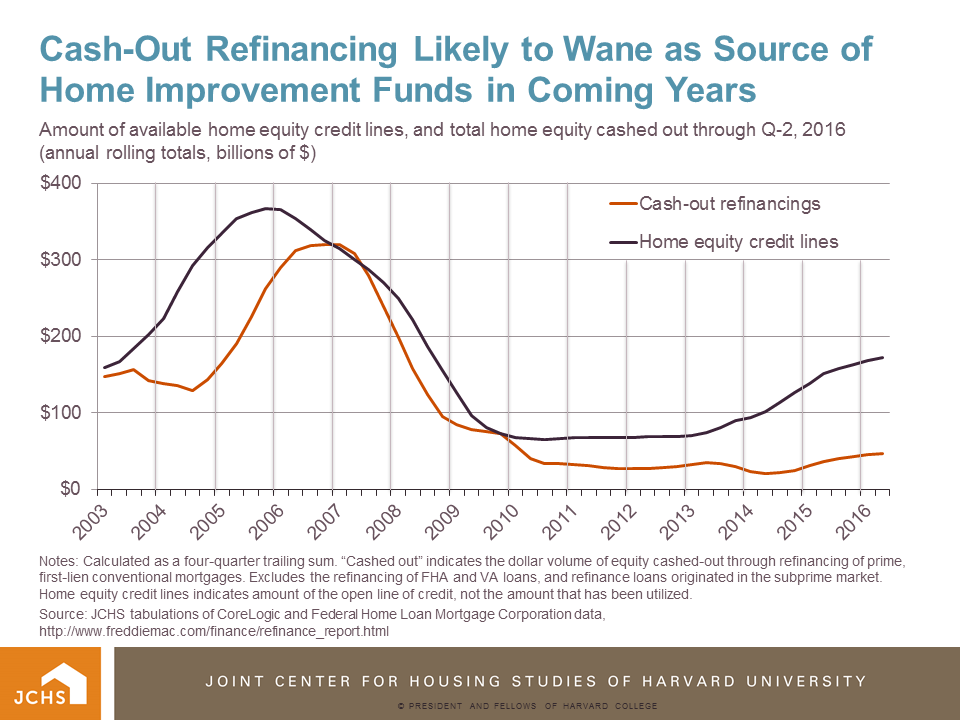
The relatively low use of home equity loans, which has in fact been trending up in recent years, is due in part to the facts that home equity levels for homeowners fell dramatically after the housing crash and lenders became more restrictive with home equity lending. However, there is another reason why these loans have fallen sharply since the housing crash. Long-term interest rates have been trending down for the past decade, and many owners who want to borrow to finance a home improvement project had another appealing and readily available option: they could refinance their principal mortgage to take advantage of lower rates, and simultaneously pull out some of their equity by increasing the loan amount on their low-interest, fixed-rate, first mortgage.

For much of the past decade, the volume of cash-out refinancing has just about equaled borrowing available through home equity credit lines. However, signs are quite clear now that we are at the end of this near decade-long interest rate down cycle. Interest rates on 30-year fixed rate mortgages, which have been trending up since last summer, spiked almost 50 basis points (one-half percentage point) after the presidential election. Noting that the incoming Trump administration is likely to push for tax cuts and infrastructure spending increases, most forecasters are projecting that long-term interest rates will continue to rise in 2017.

While higher interest rates will discourage some owners from cashing out home equity to undertake home improvement projects, they may actually promote remodeling spending by others. How can this be the case? Rising mortgage rates may encourage many owners to remain in their current homes. Interest rates for 30-year fixed rate mortgages have been below 5 percent since early 2011, so virtually everyone who has purchased a home or refinanced their fixed rate mortgage over the last six years has locked into a historically low mortgage rate. This means that if rates rise, trading up to a more desirable home also involves paying off a low interest mortgage and taking out a new higher rate loan. Facing this prospect, many owners may instead decide to improve their current home rather than buying a home with the features they now desire.

Those owners who want to tap into their growing levels of home equity to finance their home improvement projects are likely to rely on home equity lines of credit rather than cash-out refinancing. As long-term rates have stabilized near their cyclical low, we’ve already seen that homeowners are starting to rely more on home equity credit lines. In the coming months as rates trend up, the gap between home equity borrowing and cash-out refinancing is likely to widen, which, unfortunately, will expose these home equity borrowers to future hikes in short-term rates.

 Click to enlarge

Notes: Calculated as a four-quarter trailing sum.“Cashed out” indicates the dollar volume of equity cashed-out through refinancing of prime, first-lien conventional mortgages. Excludes the refinancing of FHA and VA loans, and refinance loans originated in the subprime market. Home equity credit lines indicates amount of the open line of credit, not the amount that has been utilized.


Source: JCHS tabulations of CoreLogic and Federal Home Loan Mortgage Corporation data, http://www.freddiemac.com/finance/refinance_report.html

Thursday, October 20, 2016

Growth in Remodeling Spending Projected to Peak in 2017

by Abbe Will
Research Analyst
Strong gains in home renovation and repair spending are expected to continue into next year before tapering, according to our latest Leading Indicator of Remodeling Activity (LIRA) released today. The LIRA projects that annual growth in home improvement and repair expenditures will continue to increase, surpassing eight percent by the second quarter of 2017 before moderating somewhat later in the year.

Homeowner remodeling activity continues to be encouraged by rising home values and tightening for-sale inventories in many markets across the country. Yet, a recent slowdown in the expansion of single family homebuilding and existing home sales could pull remodeling growth off its peak by the second half of 2017.

Even as remodeling growth trends back down, levels of spending are expected to reach new highs by the third quarter of next year. At $327 billion annually, the homeowner improvement and repair market will surpass its previous inflation-adjusted peak from 2006.


For more information about the LIRA, including how it is calculated, visit the JCHS website.

NOTE ON LIRA MODEL: As of April 21, 2016, the LIRA has undergone a major re-benchmarking and recalculation in order to better forecast a broader segment of the national residential remodeling market. For more information on this, see our earlier blog post, and read the research note: Re-Benchmarking the Leading Indicator of Remodeling Activity.

Thursday, August 18, 2016

Emerging Consumer Interest in Home Automation

 by Abbe Will
Research Analyst
Home automation is poised for significant growth with the rising prevalence of smartphone use, advancements in wireless technologies, and entrance of the millennial generation—the largest and arguably most tech-savvy generation to date—to the housing and home improvement markets. To better understand this emerging market segment, our Remodeling Futures program is undertaking research to measure the current and future size of this market, investigate the most promising technologies and services for homeowners, identify key players operating in the market, and explain homeowners' perceptions of the benefits and drawbacks to automating their homes.

A first look at homeowner attitudes and behaviors around home automation trends comes from a 2015 consumer survey by The Demand Institute. According to Joint Center tabulations of this survey data, of homeowners who said they were likely to do a home improvement project in the next three years, nearly half expressed excitement to incorporate more “smart home” technology into their homes, and nearly 30 percent reported that they are somewhat or very likely to install home automation products or features. About 29 percent of homeowners likely to remodel placed high importance on their homes having the latest technology, like built-in speakers, remote-controlled thermostats, electronic window coverings, etc. Another 44 percent said having the latest home technologies was somewhat important. Yet only 16 percent said that their current home could be described as already having the latest home automation technologies, which suggests a large gap in current home automation use and interest (Figure 1).

 Click to enlarge
Note: Provided examples of latest home automation technologies included built-in speakers, remote-controlled thermostats and electronic window coverings. Source: JCHS tabulations of The Demand Institute 2015 American Communities Survey: Consumer Interview data

Compared to homeowners who place little or no importance on their home having the latest automation technologies, those who place a lot of importance on home automation are younger, have higher incomes and home values, and live in more urban areas (Figure 2). These homeowners are also much more likely to be planning a home improvement project of any kind in the next three years—68 percent compared to 56 percent of those placing some importance on having the latest home technology and 44 percent for those placing little or no importance. Over half of homeowners who place a high level of importance on having high-tech homes and are likely to remodel in the coming years reported that they are somewhat or very likely to install home automation products or features (52 percent) compared to 28 percent of homeowners expressing some importance and only 10 percent of owners expressing no importance for having an automated home.

 Click to enlarge
Notes: Tabulations are of responses to the following question: How important is it to you that your home has the latest technologies, like built-in speakers, remote-controlled thermostats and electronic window coverings, etc., where 1=not at all important and 10=extremely important? Very important includes rankings of 8-10, not important includes rankings of 1-3.Source: JCHS tabulations of The Demand Institute 2015 American Communities Survey: Consumer Interview data.

There is a dramatic difference in attitudes toward home automation products and services by age of owner. Only 28 percent of homeowners age 65 and over who are likely to remodel in coming years expressed excitement to incorporate “smart home” technologies, compared to over two-thirds of owners under age 35 who either somewhat or strongly agreed with this sentiment. And where only 13 percent of homeowners age 65 and over reported being somewhat or very likely to install home automation products or features in the coming three years, almost 43 percent of owners under age 35 reported the same intent. A slightly higher share of owners age 35-44 expressed likelihood to install home automation improvements at 45 percent, but this share fell sharply for owners age 45-54 (30 percent) and age 55-64 (23 percent).

Although many homeowners are motivated to automate their homes, it is unclear how thoroughly they will act on their enthusiasm. According to a 2015 poll reported by The Demand Institute, homeowners may be hesitant to fully engage in home automation products and features because of high product costs, security flaws and glitches, and concerns for whether smart products will function as well as traditional home products. More research on the emerging home automation market will be shared in the forthcoming 2017 Improving America’s Housing report.

Thursday, July 21, 2016

Above-Average Gains in Home Renovation and Repair Spending Expected to Continue

Abbe Will
Research Analyst
Over the coming year, homeowner remodeling activity is projected to accelerate, keeping the rate of growth above its long-term trend, according to our latest Leading Indicator of Remodeling Activity. The LIRA anticipates growth in home improvement and repair expenditures will reach 8.0 percent by the start of 2017, well in excess of its 4.9 percent historical average.

A healthier housing market, with rising house prices and increased sales activity, should translate into bigger gains for remodeling this year and next. As more homeowners are enticed to list their properties, we can expect increased remodeling and repair in preparation for sales, coupled with spending by the new owners who are looking to customize their homes to fit their needs.

By the middle of next year, the national remodeling market should be very close to a full recovery from its worst downturn on record. Annual spending is set to reach $321 billion by then, which after adjusting for inflation is just shy of the previous peak set in 2006 before the housing crash.

 Click to enlarge

For more information about the LIRA, including how it is calculated, visit the JCHS website.

NOTE ON LIRA MODEL: As of April 21, 2016, the LIRA has undergone a major re-benchmarking and recalculation in order to better forecast a broader segment of the national residential remodeling market. For more information on this, see our earlier blog post, and read the research note: Re-Benchmarking the Leading Indicator of Remodeling Activity.

Tuesday, April 26, 2016

The Rising Tide of Online Home Services


Grant Farnsworth
The Farnsworth Group
The swell of young homeowners and the rapid evolution of the online home services market could lead to a big wave of growth in this sector over the coming years. But how aware are consumers of the availability of these services, and how is the industry responding to this new wave of offerings?

Guest post by Grant Farnsworth of The Farnsworth Group, a member of the Joint Center Remodeling Futures Steering Committee. The blog is based on a recent presentation to the Remodeling Futures group.

GM investing $500M in Lyft, Google investing in Uber, The Home Depot buying Red Beacon, the launch of Amazon Home Services… these large players know something is in the water when it comes to online services. We appear to be witnessing “Uber-ization” of the home services market.

As the platform matures, important questions are beginning to take shape.
  • What exactly are online home services? How is this space being defined?
  • Who is using these services?
  • Are the users’ needs being met?
Early evidence suggests that while millennials are beginning to latch onto these services, older owners are less engaged, and home improvement contractors generally aren’t viewing these service delivery models either as potential partners or as competition to their current business models.


To gain insights on the use and perceptions of online home services, The Farnsworth Group completed a study that surveyed homeowners who had recently hired a service professional. Also surveyed were remodelers and specialty contractors, to better understand their awareness of – and potential integration with – these service delivery models. For this survey, online home services were defined as “websites or apps that are intended to help homeowners and service professionals with home design, home improvement, and/or home repair and maintenance projects”.

Given their relatively recent introduction, much of the population is largely unaware of these services. Both homeowners and professionals view these platforms to best fit with modest improvement and repair projects in the under $5,000 range. Both groups also indicate similar features that are important to them when working with a service pro or client. However, that is where many similarities end. Results show dramatic differences in the adoption of online home services by younger homeowners, older homeowners, and contractors.

Homeowners who hired a service professional within the last 12 months were asked which of the following services they have ever used, or currently use: Angie’s List, HomeAdvisor, Houzz, Porch, TaskRabbit, Thumbtack, and Pro.com. Homeowners between the ages of 21-34 are much more likely to have consulted these home services, and used them in their selection process. Nearly 75% of those using online home services end up hiring a service professional from one of the services.

Online Service
21-34
N=187
35-49
N=284
50-64
N=291
65+
N=192
Angie’s List
36.4%
31.3%
22.0%
16.1%
Home Advisor
27.3%
20.4%
14.1%
10.9%
Houzz
17.1%
13.4%
6.5%
2.6%
Porch
12.3%
2.8%
1.0%
0.5%
TaskRabbit
12.8%
4.6%
1.0%
0.5%
Thumbtack
10.2%
4.2%
4.8%
1.6%
Pro.com
15.5%
3.2%
1.7%
0.0%

However, when remodelers and the trades were asked what apps and websites they have used or are currently using, they are often not as engaged with online home services as homeowners, and certainly not as engaged as younger homeowners.

Online Service
Remodeler
N=473
Specialty Tradesmen
N=206
Angie’s List
27.1%
26.7%
Home Advisor
18.2%
22.3%
Houzz
25.2%
9.2%
Porch
8.0%
4.4%
TaskRabbit
3.0%
0.5%
Thumbtack
6.6%
5.8%
Pro.com
2.3%
5.8%


Younger homeowners in the study were also generally more willing to engage home service sites. Over three-quarters of millennials are somewhat to extremely willing to do business online, a figure that drops closer to 50% for boomers.

 click to enlarge


So what is driving homeowners and professionals alike to utilize these new online home services platforms? Homeowners that have used online service sites use them for a variety of reasons, but three stood out in the survey:
  • Getting project estimates/costs
  • Information on the home services provider
  • Being matched with a home services provider
However “being matched with a service pro” is low on their list of importance when it comes to homeowners hiring a service professional. The majority use “word of mouth” for getting a few contractor names.

Remodelers and trades professionals, on the other hand, use online home service sites to generate leads, get design ideas, and market their company. Unfortunately, these features also do not align with what the survey showed was most important to them:
  • Communicating with clients
  • Managing projects
  • Providing estimates
Getting leads via an online service is of little importance because, like homeowners, nearly all contractors get leads from “word of mouth”.

It is clear that the features of online home service sites do not always align with what’s most important to the users. The gap between what’s important and how online service sites are being used indicates either a lack of understanding as to what the platforms provide, OR a failure for the platform to provide appropriate services.

Regardless of the needs for knowledge, education, and platform development that this study illuminates, young homeowners are extremely likely to utilize these online home services sites. They also perceive these sites to be “more beneficial” and “easier to use” than traditional “offline” methods. In contrast, the professionals we surveyed, while willing to test the waters, do not share as much enthusiasm as younger homeowners.

Those who utilize online service sites may see it pay off given the increasing use and high conversion rates. Millennials are the largest generation in our history, and as such are the generation with the most future buying power. As they continue to enter the homeowner market, awareness and use of online home services seems inevitable. With that will come more informed and educated consumers, which should propel a modest swell in online home services to something much, much more significant.

So home improvement professionals are well advised to grab a surfboard, paddle out, and be prepared, because they may catch a killer wave to ride with the new generation of home buyers.


For the complete study results contact The Farnsworth Group at info@thefarnsworthgroup.com or 317-241-5600 x.301.