Showing posts with label interest rates. Show all posts

Monday, March 27, 2017

What Impact Do Changing Interest Rates Have on Mortgage Demand?

by Stephanie Lo
JCHS Meyer Fellow
Could the post-Great Recession drop in housing demand have been driven in part by an increase in mortgage credit spreads across borrowers? In a new Joint Center working paper that uses proprietary data on the spread of mortgage rates across borrowers with different credit, I find that mortgage demand does react to mortgage interest rates in economically and statistically significant ways. 

This finding is significant because little is known about the extent to which changes in interest rates affect the demand for mortgages. Measuring this effect is difficult because both interest rates and the demand for mortgages are driven by macroeconomic factors. For example, after the financial crisis in the late 2000s, interest rates fell as the Federal Reserve attempted to stimulate the economy, but the demand for mortgages also fell because individuals faced adverse macroeconomic conditions. A naive estimate would suggest that over this period, lower interest rates drove lower housing demand, which is clearly not correct.

My study uses Loan Level Price Adjustments (LLPAs) to address this issue.  Instituted by FHFA in November 2007, LLPAs are additional fees paid upfront by the lender to Fannie Mae or Freddie Mac. The fees are higher for loans with higher loan-to-value ratios and borrowers with lower credit scores, and feature discrete cutoffs at certain credit scores, as measured at mortgage origination. Put simply, a borrower with a 700 credit score will face the same LLPA as a borrower with a 701 credit score, but will benefit from a discretely lower LLPA than a borrower with a 699 credit score.

Using administrative mortgage rate data, I find that LLPAs are completely passed through to borrowers, so while lenders receive the same mortgage rate across credit scores, borrowers just below a credit-score cutoff pay a higher mortgage rate than those just above that cutoff point (Figure 1). I further show that borrowers across these credit scores are virtually identical, and for high credit scores, lenders do not differentially screen across these cutoffs. This allows me to apply a regression-discontinuity design to examine how mortgage demand changes for borrowers just above and below several credit score cutoff points—660, 680, 700, and 720—where the interest rates offered to borrowers change. 

Notes: Rates are for conforming 30-year FRM. The numbers shown reflect the mean across the entire baseline sample for the exact FICO score shown, on the weekly level, from October 2008 to December 2014. Higher FICO scores tend to benefit from lower mortgage rates due to lower upfront payments induced by LLPAs. Source: Optimal Blue and Fannie Mae; Author’s calculations.

The results show that borrowers respond to changes in interest rates in economically and statistically significant ways (Figure 2). I estimate that a 25 basis point cut in interest rates results in a 50 percent increase in the likelihood of a potential borrower to demand a loan. In a given month, this increases the number of mortgage originations from about 100 per 100,000 individuals to 140 per 100,000 individuals. I also find that a 25 percent basis point cut in interest rates results in an increase in loan size of approximately $15,000, or about 10 percent of the average origination volume.

Notes: The mortgage rate series comes from the Freddie Mac Primary Mortgage Rates survey. Mortgage originations data is calculated as the total recorded origination amount for purchase mortgages by year, using the proprietary McDash LLC data.

These estimates help to explain the post-crisis drop in mortgage demand from low-income and low-credit borrowers. A back-of-the-envelope calculation using my estimates suggests that, had 680-719 FICO borrowers been subject to the same LLPA as 720 FICO borrowers, this group would have generated $15 billion more in mortgage demand over six years, which would have been a 33 percent increase in mortgage lending to this group alone. More generally, my estimates suggest that borrowers were very sensitive to mortgage rates after the crisis, implying that the Federal Reserve’s efforts to lower interest rates, which in turn lowered mortgage rates, may have been very effective in bolstering the housing market.

Friday, December 16, 2016

Rising Interest Rates, and What They Mean for Home Improvement

by Kermit Baker
Director, Remodeling
Futures Program
The recent hike in short-term interest rates by the Federal Reserve Board has raised concerns about what rising interest rates mean for consumer borrowing, particularly how they will affect the demand for home improvement loans. The counterintuitive but probable outcome is that home improvement borrowing is likely to increase, and that borrowers will rely more heavily on loans tied to short-term interest rates, which are expected to rise significantly over the coming year.

Why is this likely to occur?  To begin, it is worth noting that owners undertaking home improvement projects, even larger projects, rely heavily on savings to pay for these projects. Findings from a October 2016 Piper Jaffray Home Improvement Survey are consistent with previous consumer surveys regarding how owners pay for major home improvement projects. Savings continue to be the principal source of funds as 62 percent of respondents planning a project indicated that they would use savings for all or part of the payment. Another 37 percent said they would put all or part of the cost on a credit card, with many of these planning to immediately pay off their balance. In contrast, only 18 percent said they planned to use a home equity line of credit to fully or partially fund their projects.

The relatively low use of home equity loans, which has in fact been trending up in recent years, is due in part to the facts that home equity levels for homeowners fell dramatically after the housing crash and lenders became more restrictive with home equity lending. However, there is another reason why these loans have fallen sharply since the housing crash. Long-term interest rates have been trending down for the past decade, and many owners who want to borrow to finance a home improvement project had another appealing and readily available option: they could refinance their principal mortgage to take advantage of lower rates, and simultaneously pull out some of their equity by increasing the loan amount on their low-interest, fixed-rate, first mortgage.

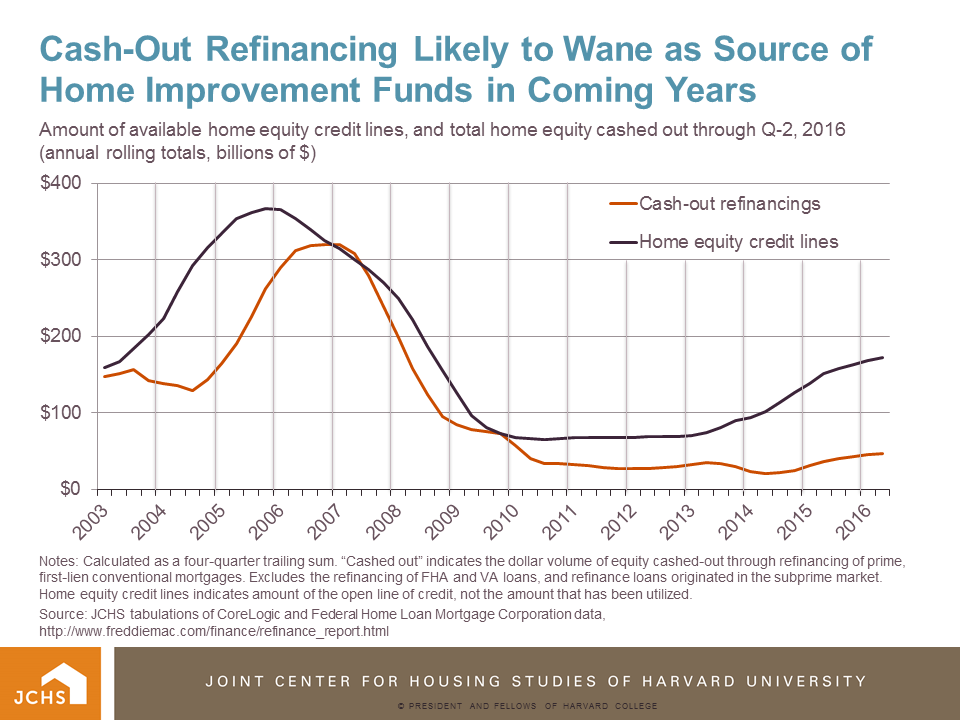
For much of the past decade, the volume of cash-out refinancing has just about equaled borrowing available through home equity credit lines. However, signs are quite clear now that we are at the end of this near decade-long interest rate down cycle. Interest rates on 30-year fixed rate mortgages, which have been trending up since last summer, spiked almost 50 basis points (one-half percentage point) after the presidential election. Noting that the incoming Trump administration is likely to push for tax cuts and infrastructure spending increases, most forecasters are projecting that long-term interest rates will continue to rise in 2017.

While higher interest rates will discourage some owners from cashing out home equity to undertake home improvement projects, they may actually promote remodeling spending by others. How can this be the case? Rising mortgage rates may encourage many owners to remain in their current homes. Interest rates for 30-year fixed rate mortgages have been below 5 percent since early 2011, so virtually everyone who has purchased a home or refinanced their fixed rate mortgage over the last six years has locked into a historically low mortgage rate. This means that if rates rise, trading up to a more desirable home also involves paying off a low interest mortgage and taking out a new higher rate loan. Facing this prospect, many owners may instead decide to improve their current home rather than buying a home with the features they now desire.

Those owners who want to tap into their growing levels of home equity to finance their home improvement projects are likely to rely on home equity lines of credit rather than cash-out refinancing. As long-term rates have stabilized near their cyclical low, we’ve already seen that homeowners are starting to rely more on home equity credit lines. In the coming months as rates trend up, the gap between home equity borrowing and cash-out refinancing is likely to widen, which, unfortunately, will expose these home equity borrowers to future hikes in short-term rates.

 Click to enlarge

Notes: Calculated as a four-quarter trailing sum.“Cashed out” indicates the dollar volume of equity cashed-out through refinancing of prime, first-lien conventional mortgages. Excludes the refinancing of FHA and VA loans, and refinance loans originated in the subprime market. Home equity credit lines indicates amount of the open line of credit, not the amount that has been utilized.


Source: JCHS tabulations of CoreLogic and Federal Home Loan Mortgage Corporation data, http://www.freddiemac.com/finance/refinance_report.html

Thursday, April 16, 2015

Slowing Growth in Home Renovations Should Stabilize by Year’s End

by Abbe Will
Research Analyst
The healthy gains in residential remodeling activity estimated for 2014 and the first part of 2015 are expected to decelerate, but then gain a little more traction by the end of the year, according to our latest Leading Indicator of Remodeling Activity (LIRA), released today. The LIRA projects annual spending for home improvements will increase a more modest 2.9% in 2015.

One of the largest contributors to this dampening of remodeling growth in 2015 is the sluggish existing home sales activity last year. Housing turnover typically sparks significant improvement spending as new owners customize their recent purchases to fit their needs and, with sales down last year, remodeling will feel the effects this year.

Moving forward, signs of higher growth in remodeling activity include strengthening retail sales of building materials. Also, rising home equity and still favorable interest rates continue to encourage owners to reinvest in their homes.”

NOTE ON LIRA MODEL:  Beginning with the first quarter 2014 release, long-term interest rates were removed from the LIRA estimation model.  For more information on the reasons for and implications of this change, please read our blog post from April


For more information about the LIRA, including how it is calculated, visit the Joint Center website.

Thursday, January 22, 2015

What Effect Will Lower FHA Mortgage Insurance Premiums Have on First-Time Homebuyers?

by Dan McCue
Research Manager
As mentioned in Tuesday’s State of the Union address, the Federal Housing Administration (FHA) announced that it will lower costs of government mortgages by reducing the annual Mortgage Insurance Premium (MIP) rate on most of its new single family home loans by 50 basis points, beginning on January 26. This left many wondering what exactly this means for borrowers and, in particular, what effect it might have on first-time homebuyers who make up a high portion of FHA borrowers and who largely remain on the sidelines.   

The MIP is a fee that FHA charges borrowers to maintain a reserve of funds necessary to insure lenders against losses on its loans. Since the MIP cost is assessed annually as a percent of outstanding principal and then divided across 12 monthly payments, the effect of the drop in MIP rate is in many ways similar to a change in the interest rate of a loan. But the MIP payment is added on top of monthly principal and interest payments, so it does not factor into amortization schedules in quite the same way as interest rates. Additionally, unlike interest payments that change month to month as a borrower pays down the loan balance, the MIP amount is also recalculated just once a year and remains fixed for that time. FHA also charges an up-front mortgage insurance premium (UFMIP) that is a one-time fee incurred at the origination of the loan, which remains unchanged by the recent announcement and currently stands at 1.75 percent of the original loan balance for most FHA loans.

This recent move to lower the MIP comes after several rounds of increases made to cover losses to FHA loans following the housing bust. Even after tightening lending standards and four rounds of MIP increases starting in 2010 (see Table 1), FHA was still forced to draw $1.7 billion from the Treasury in 2013 to remain solvent.  However, FHA’s FY2014 annual report, released in November, shows the FHA Mutual Mortgage Insurance Fund grew by $6.1 billion last year to a positive $4.8 billion in value. Although the capital ratio remains at just 0.41 percent, still well below the legally-mandated capital ratio of 2 percent, the tide has apparently turned and, as pointed out in a recent Urban Institute analysis, financial projections must suggest there is room for FHA to reduce MIP on new loans while still growing its reserves. Indeed, as we see in table 1, the new, lower MIP rates are still well above levels prior to October 2010.

Table 1: History of FHA mortgage insurance premium changes

Date of Change
<=95.0% LTV
> 95.0% LTV
FHA Announcement
Prior to October 4, 2010
50 bps
55 bps
October 4, 2010
85 bps
90 bps
Mortgagee Letter 10-28
April 18, 2011
110 bps
115 BPS
Mortgagee Letter 11-10
April 9, 2012
120 bps
125 bps
Mortgagee Letter 2012-4
April 1, 2013
130 bps
135 bps
Mortgagee Letter 2013-4
January 26, 2015
80 bps
85 bps
Mortgagee Letter 2015-01

Note: Rates shown are for 30-year mortgage that is no greater than $625,500.

So what is the impact of this change? The 50 basis point reduction in the FHA MIP rate amounts to a difference of $500 per year, or about $42 a month for every $100,000 of mortgage balance. Based on the current median home sales price, the administration announced that the average borrower will see a reduction in costs of about $900 per year. Likely this will have some impact at the margins. For first-time homebuyers, to whom fully 75 percent of FHA loans in FY2014 were originated, the modest increase in affordability could result in a short-term bump in sales activity that may or may not be measurable. 

To see how this change may affect first-time homebuyers, we look at the impact on home purchasing power for the typical renter. According to data from the Census bureau, the median renter household had an income of about $34,000 at last measure in 2013. Assuming this renter obtains an FHA mortgage with 3.5 percent down, a 4 percent interest rate and maintaining a 31 percent front end debt to income ratio – which is the published limit for FHA manually underwritten loans - the change in MIP increases the amount of house they could potentially afford from about $152,000 to $163,000, or about 7 percent. This price is still well below the most recent published NAR median home sales price of $205,300, but nonetheless amounts to an increase of $11,000 in home purchasing power for this borrower – also equivalent to a 6.7 percent drop in home price – that may open up a few more buying opportunities depending on the number of homes available on the market in this price range. The administration announcement estimated this at approximately 250,000 additional buyers over three years. 

What is not addressed by the analysis of the new MIP rates is the extent to which they will help those with less than stellar credit. FHA lenders use credit overlays to narrow the field of potential borrowers to those with the highest credit ratings. These and other credit barriers – evidenced by the still-historically elevated median credit score of the typical FHA borrower - are likely much more limiting to first-time homebuyers than affordability of mortgage insurance payments.  At the same time, rising home prices and/or interest rates may prove to have much more of an impact on affordability over the coming months. At the end of the day, however, the result is that this is a modest step that most likely won’t jeopardize the financial standing of FHA but will increase mortgage affordability for thousands of FHA borrowers and potentially even increase home buying opportunities at the margins at a time when credit remains tight, home sales are sluggish, and first-time home buying is struggling - which seems like a step in the right direction.      

Thursday, July 17, 2014

Interactive Map: Where Can Renters Afford to Own?

by Rocio Sanchez-Moyano
Research Assistant
Homebuyer affordability remains near an all-time high, so where are all the first-time homebuyers? According to indexes that incorporate gross measures of house prices, interest rates, and household incomes, affordability remains at unprecedented levels. The National Association of Realtors® index, for instance, shows that the median-income household can afford to buy a home in all but 7 percent of the largest metros. Given that affordability looks good on paper, the lack of first-time homebuyers in all metros has been surprising. In 2013, first-time homebuyers made up 38 percent of home purchases, below the historical average of 40 percent, dating back to 1981. The most recent American Housing Survey shows that 3.3 million households were first-time buyers in 2009-2011, a 22 percent drop from the 2001 survey, which covered 1999-2001. This decline in first-time buyers comes in spite of real mortgage payments for the median home that remain below $800 (levels unprecedented before the recession) and a 7 percentage point decline in the mortgage payment-to-income ratio since 2001.

Affordability indexes typically use median home prices and median incomes to estimate affordability, but it can be difficult to calculate the number of potential first-time buyers from these indexes, as median incomes differ for renters and owners and across age groups. To better estimate affordability for potential first-time homebuyers, the JCHS looked at how many renters in the age group most likely to be first-time homebuyers (25-34) have enough income to afford the costs of owning in different metro areas. Analysis was performed on the top 100 metros by population for which National Association of Realtors® quarterly median existing single-family home price data was available, resulting in 85 metros included in the final analysis. Affordability in this analysis is defined by the maximum debt-to-income ratio established in the Qualified Mortgage (QM) rule that went into effect in January of this year. The median home is considered affordable in this analysis if mortgage payments, with a 5 percent downpayment (more typical for first-time buyers), property taxes and insurance, and non-housing debt payments make up no more than 43 percent of a household’s income (extended metholodogy).

Historically, the majority of first-time buyers are households aged 25-34. Looking at renters in this age group, most would find the monthly costs of homeownership affordable in many metros across the country. Indeed, in 42 of the 85 metros studied, more than half of renters can afford the monthly costs of homeownership. Nearly 30 percent of the 25-34 year old renters in our sample lived in these affordable metros. Only in six metros, concentrated almost exclusively in California, are renter incomes so low compared to house prices that less than 30 percent of renters aged 25-34 can afford the costs of owning.

Click to launch interactive map


So why, given that so many metros are affordable to potential 25-34 year old first-time buyers, has the first-time buyer share remained low? Many demographic and economic forces are constraining the transition to homeownership for renters in their 20s and 30s. The first is the fundamental mismatch between incomes and prices as shown in this analysis. Even in the metros where the majority of renters 25-34 could afford monthly homeowner costs for the median home, more than one-third of renters in this age group cannot. Real renter income for households aged 25-34 remains at some of its lowest levels in more than a decade. The unemployment rate for this age group peaked above 10 percent in 2010 and stayed above 7 percent throughout 2013. Also, as we indicated in our recent State of the Nation's Housing report, an additional 2.4 million households in their 20s and 30s were living with their parents in 2013 (than if the share living at home had remained at 2007 levels). Aside from covering monthly homeowner costs, unemployment and income stagnation mean that even in the lowest-cost metros in this analysis, many potential buyers cannot afford at least $5,000 for a 5 percent downpayment. Finally, 39 percent of 25-34 year old households have student loan debt and often allocate a larger share of their monthly income to student loan payments than older households. As the economy improves, however, there should be more willingness and ability by these households to become first-time buyers.

Thursday, April 17, 2014

Favorable Financing Costs Not Impacting Remodeling Activity During Recovery

by Abbe Will
Research Analyst
Follow on Twitter
Solid growth is expected in the home remodeling market this year, according to the Leading Indicator of Remodeling Activity (LIRA) released today by the Joint Center. While annual growth is expected to decelerate some by the fourth quarter due partly to the ongoing sluggishness in home sales, home improvement spending is still expected to grow nine percent in 2014. In the near term, lower rates of household mobility and lean inventory levels of homes on the market seem to be helping the home improvement industry. That coupled with an aging housing stock and deferred expenditures during the recession have owners catching up with delayed remodeling projects this year. Another factor that would normally help boost remodeling spending is low financing costs, but as described below historically low interest rates are not having the same impact on home improvements in current market conditions.

Produced by the Remodeling Futures Program since 2007, the LIRA is a short-term indicator of national trends in home improvement spending. The LIRA is calculated as a weighted average of the annual rates-of-change of its component inputs, which are various economic measures that historically have had strong correlations and leads over remodeling activity. With the release of the First Quarter 2014 LIRA today, a decision was made to change the estimation model by removing the financial market conditions input (as measured by long-term interest rates), because the traditional relationship between interest rates and home improvement spending has significantly deteriorated in recent years. As seen in Figure 1, the impact of this change is slightly lower rates of growth in annual home improvement spending estimated for the past several quarters and substantially higher rates of growth projected for the next three quarters. Under the original LIRA estimation model, homeowner expenditures on remodeling projects are projected to increase about three percent in 2014, while the revised model projects spending will increase nine percent this year.


Note: The revised LIRA model excludes 30-year Treasury bond yields as an input and reweights the remaining inputs proportionally.  
Source: Joint Center for Housing Studies of Harvard University.  

Major changes to the LIRA estimation model have not been common. The last significant change occurred in 2008 when the LIRA was re-benchmarked from the Census Bureau’s Residential Improvements and Repairs Statistics (C-50) to the Construction Spending Value Put in Place (C-30). The reason for changing the LIRA model at this time is because since 2008, the severe housing and the mortgage market crash and subsequent Great Recession has caused unprecedented volatility in many of the LIRA inputs including the financing measure represented by 30-year Treasury bond yields. The theory behind including a financing measure in the LIRA model is that under more normal housing and economic environments, large home improvement projects are often financed by homeowners through home equity loans or lines of credit or cash-out refinancing of mortgages, and so the historically low financing costs of recent years would ordinarily encourage significant remodeling activity.  Yet under the current conditions of a stalled housing market and still lukewarm economic environment, homeowners have not been able to take advantage of historically low financing costs because of much reduced levels of equity in their homes since the housing crash, as well as tighter lending practices of banks. For these reasons, the historically low interest rates of the past two years did not have the same influence on remodeling activity as in the past. Since the fall in rates did not result in a jump in spending, the recent rise in rates are also not expected to have as much of a chilling effect on remodeling spending as in the past. 

Indeed, as shown in Figure 2, the relationship between the annual rates of change in home improvement spending and 30-year Treasury bond yields was fairly strong when the LIRA estimation model was last updated in mid-2008 with a correlation coefficient of 0.7 between 2000 and 2007 (remodeling spending and interest rates are inversely correlated so that when interest rates increase spending declines and vice versa). While long-term interest rates are historically quite stable, since the housing and mortgage market crisis interest rate changes became unusually volatile as interest rates fell to historic lows and again as rates move off of these lows. Not only have interest rate movements become much more volatile, but the direction of change no longer correlates well with remodeling spending. When including data from the more recent period that covers the downturn and recovery, the correlation coefficient between remodeling spending and long-term interest rates weakens considerably to 0.2 and in fact there is essentially no correlation between the two series after 2008. If the traditional relationship between financing costs and remodeling activity were still intact, much stronger growth in home improvement spending should have occurred when interest rates fell to historic lows in the aftermath of the housing crash, and now as interest rates return to their longer-term trend remodeling activity would be expected to decline considerably. Yet remodeling spending has seen relatively low and stable growth in the years following the downturn.


Note: The rate of change in Treasury bond yields are plotted inversely and with a four-quarter lead
Source: JCHS tabulations of Census Bureau’s C-30 and Federal Reserve Board 30 Year Treasury Bond Yields
.

Given the increased volatility in the C-30 benchmark data series and the LIRA inputs in recent years as the housing and home improvement markets have undergone severe cyclical downturns and sluggish recoveries, there is clearly a need for further testing of the LIRA estimation model moving forward to improve its stability. Each year on July 1st, the Census Bureau releases annual revisions to the C-30 for the prior two years, which provides a good opportunity for re-running LIRA input correlations and testing for further additions or substitutions of input variables that historically correlate well with remodeling spending, have strong leads over spending, and are also relatively stable over time. Any further changes to the LIRA model will be announced with the next quarterly release on July 24, 2014. For more information about the LIRA methodology and frequently asked questions (FAQs), please see the Joint Center for Housing Studies website.

Thursday, January 16, 2014

Double Digit Growth in Remodeling Spending Expected Through Mid-Year

by Abbe Will
Research Analyst
The home remodeling market should see strong growth in 2014, according to our latest Leading Indicator of Remodeling Activity (LIRA).  The double-digit gains in annual home improvement spending projected for the first half of the year should moderate some to just under 10 percent by the third quarter.

The ongoing growth that we’ve seen in home prices, housing starts, and existing home sales is also being reflected in home improvement activity. As owners gain more confidence in the housing market, they are likely to undertake home improvements that they have deferred.  However, the strong growth for this cycle may start to ebb a bit beginning around midyear.  By that time, we’ll be approaching the pre-recessionary levels of spending, and with borrowing costs starting to creep back up, growth rates are likely to slow some.  (Click chart to enlarge.)


For more information about the LIRA, including how it is calculated, visit the Joint Center website.

Wednesday, July 31, 2013

Remodeling Gains Expected to Continue Into 2014

by Abbe Will
Research Analyst
In our July 16 blog, Census Bureau Remodeling Data Revisions Out of Sync with Other Market Indicatorswe indicated that there would not be a Leading Indicator of Remodeling Activity (LIRA) this quarter due to unusually volatile revisions to home improvement spending data collected by the U.S. Census Bureau.  On July 18, 2013, however, Census announced corrections to their annual revisions and today we are releasing our LIRA. 


General strengthening in the housing market over the past 18 months is translating into increased spending on home improvements. Remodeling contractors have been reporting improving market conditions for the past four quarters, and are seeing strength in future market indicators.  Spending trends have been on a solid upward slope, with the LIRA projecting continued strengthening of the market through the end of this year and into the first quarter of 2014.

Homeowners are more comfortable investing in their homes right now. Consumer confidence scores are back to pre-recession levels, and since recent homebuyers are traditionally the most active in the home improvement market, the growth in sales of existing homes is providing more opportunities for these improvement projects.

Yet, with housing starts leveling off in the second quarter and financing costs beginning to edge up, we may be seeing the beginning of more measured growth in the residential markets. Given normal timing patterns, this suggests that the pace of growth for home improvement spending should begin to moderate as we move into 2014.

(Click chart to enlarge)


For more information about the LIRA, including how it is calculated, visit the Joint Center website.

Wednesday, June 26, 2013

A Housing Recovery, but Not for All Americans

by Eric Belsky
Managing Director
Driven by rising home prices and growing demand, the U.S. housing recovery is well underway, according to our latest State of the Nation’s Housing report released today. While still at historically low levels, housing construction has finally turned the corner, giving the economy a much-needed boost. But even as the recovery gains momentum, millions of homeowners are still delinquent on their mortgages or owe more than their homes are worth, and severe housing cost burdens have set a new record.

Driven by an increase of 1.1 million renter households, last year marked the second consecutive year of double digit percentage increases in multifamily construction. But the flip side of the strong rental market was the continued slide in homeownership rates. Even as historically low interest rates have helped make the monthly cost of owning a home more favorable than any time in the past 40 years, the national homeownership rate fell for the eighth straight year in 2012. The drop was especially pronounced for 25–54 year olds, whose homeownership rates were at their lowest point since recordkeeping began in 1976.

Note: White and black households are non-Hispanic; Hispanic households can be of any race.
Source: JCHS tabulations of US Census Bureau, Current Population Surveys.


Tight credit is also limiting the ability of would-be homebuyers to take advantage of today’s affordable conditions and likely discouraging many from even trying.  At issue is whether, and at what cost, mortgage financing will be available to borrowers across a broad spectrum of incomes, wealth, and credit histories moving forward.

And while the recovery is good news for many, the number of Americans shelling out half or more of their incomes on housing is at an all-time high. At last count, 20.6 million households were shouldering such severe burdens, including nearly seven out of ten households with annual incomes of less than $15,000 (roughly equivalent to year-round employment at the minimum wage). But, the report notes, even as the need has never been greater, federal budget sequestration will pare down the number of households receiving rental housing assistance.


Notes: Severely cost-burdened households spend more than 50 percent of pre-tax income on housing costs.  Incomes are in constant 2011 dollars, adjusted for inflation by the CPI-U for All Items.
Source: JCHS tabulations of US Census Bureau, American Community Surveys.


With rising home prices helping to revive household balance sheets and expanding residential construction adding to job growth, the housing sector is finally providing a much needed boost to the economy, but long-term vacancies are at elevated levels in a number of places, millions of owners are still struggling to make their mortgage payments, and credit conditions for homebuyers remain extremely tight. It will take time for these problems to subside. Given the profoundly positive impact that decent and affordable housing can have on the lives of individuals, families, and entire communities, efforts to address these urgent concerns as well as longstanding housing affordability challenges should be among the nation’s highest priorities.

Download the 2013 State of the Nation's Housing report.

Watch our webcast of the report's release.


Thursday, May 30, 2013

Despite Rising Home Prices, Homeownership More Affordable than Ever

by Rocio Sanchez-Moyano
Research Assistant
For those able to obtain loans in today’s constrained credit environment, the monthly cost of homeownership is at historic lows, thanks to low interest rates.  Though the National Association of Realtors’ median single family home price increased by 6 percent in 2012, falling interest rates have made mortgage payments cheaper: assuming a 20 percent down payment and 30-year fixed-rate mortgage, monthly payments on a median priced home in 2012 were $644. Compared to median incomes, payments are lower than they have been in more than two decades.

Sources: JCHS tabulations of Freddie Mac, Primary Mortgage Market Survey; National Association of Realtors;  US Census Bureau, Moody’s Analytics Estimates.

The record low interest rates available in 2012 helped reduce monthly mortgage payments in 82.9 percent of metros from 2011 to 2012; payments also declined in 80.3 percent of metros that experienced price gains.  Even in metros with substantial price appreciation, such as Phoenix (24.6 percent) and San Francisco (11.9 percent), growth in mortgage payments was muted, rising 13.3 and 1.7 percent, respectively.  In fact, interest rate declines over the last year were enough to offset price increases of up to 10 percent price appreciation.

The current interest rate environment would keep payment-to-income ratios affordable for median buyers in a majority of cities even under much larger price increases.  Following the methodology used by the National Association of Realtors (NAR) in calculating their housing affordability index, a mortgage payment is considered affordable if it represents no more than 25 percent of monthly income.  Using this as a threshold, mortgage payments on a median priced home were affordable in more than 95 percent of metros in 2012.  Even if house prices were to rise by 20 percent, without a change in interest rates, 91.5 percent of metros would remain affordable to the median buyer.  In fact, the cost of a nationally median-priced home would have to increase by more than 72.1 percent to become unaffordable at the median household income.  Interest rates are so far below their historical average that few metros would become unaffordable to the median buyer even with moderate changes in interest rate.  For example, if interest rates increased to 5 percent, comparable to rates in 2009, only 2 percent more metros would become unaffordable to the median buyer.

Though mortgage payments are at historic lows, purchasing a home is still unaffordable for many prospective buyers.  In some traditionally expensive markets, such as the large California metros and Honolulu, monthly mortgage payments were already too costly for the median homebuyer in 2012.  For first time homebuyers, whose payments are approximated using a 10 percent down payment on a home priced at 85 percent of the median, and incomes of 65 percent of the median, 17.1 percent of metros were unaffordable.  The effect is more pronounced in the largest 20 metros, as 35 percent of them are unaffordable to first time buyers. (Click table to enlarge.)


Notes:  Payments and payment-to-income ratios for the median homebuyer assume a 30-year fixed-rate mortgage with 20 percent down payment on a median priced home and median income for the metro; for a first time homebuyer, payments and payment-to-income ratios assume a 30-year fixed-rate mortgage with a 10 percent down payment on a home priced at 85 percent of the median and an income of 65 percent of the median, as per the NAR first time homebuyer affordability index. Sources: JCHS tabulations of Freddie Mac, Primary Mortgage Market Survey; National Association of Realtors; US Census Bureau, Moody’s Analytics Estimates.

While it is likely that homeownership will remain affordable in the short term, these historic levels of affordability may not last.  Prices increased in 86.6 percent of metros from 2011-12 and interest rates were slightly higher in the first months of 2012 than at the end of 2012, according to the Primary Mortgage Market Survey issued by Freddie Mac.  Buyers who were waiting for the best deal as prices and interest rates continued to drop before entering the market may be spurred by current trends to think that this may be the ideal time to buy.

Wednesday, February 13, 2013

Watch the Inventory – and the Investors

by Eric Belsky
Managing Director
As housing demand has been coming up, the inventory of homes for sale on the market has been going down.  This tightening of supply relative to demand is the bedrock of the recovery. It gives consumers confidence and a sense of urgency to buy.

Those interested in the course of home prices should watch inventory levels, especially relative to demand.  Multiple listing services (MLS) provide measures of inventories at the metropolitan level and typically even for submarkets within them.  If you start to see inventories in a market climb, the recovery in prices—and demand which is partly linked to the urgency created by rising prices—may not stay on course.

In assessing housing market recovery, then, an important question is what is in store for inventories of homes for sale.  Will demand at some point be outstripped by inventory growth as new home building ramps up again and more existing owners place their homes on the market because of rising prices?

The answer to this question of course will hinge on conditions in individual housing markets.  Broadly speaking, the dynamics will likely differ depending on the share of homeowners in a market who are underwater and the activity of investors in single-family rental properties.

In places where only a small fraction of homeowners are underwater, rebounding homes prices may be enough to spark owner interest in selling their existing homes to trade up or down.  With interest rates so low and the potential to move unfettered by negative net equity, many may start to feel that now is the time to sell.

In places where many owners are deeply underwater, however, even a strong single-digit increase in home prices may not be enough to induce many owners to place their homes on the market.  After all, they would still have to write a check at the closing table if they did. Therefore, one would expect inventories to fall more in places with negative net equity as demand picks up because homeowner interest in selling does not follow suit.

In fact this is precisely what seems to be occurring. Inventories have fallen more sharply and asking prices risen more in areas with more underwater homeowners (click figure to enlarge). 

JCHS tabulations of data from CoreLogic and www.deptofnumbers.com

However, the buyers of these homes are not necessarily individuals looking to move. In many of these places much of the demand has come from investors who snapped up homes at low prices and then rented them out. Figure 2 lists places where there has been a significant shift in the share of single-family homes that are rented. These are the markets where investors have been most active, helping to soak up the excess supply of distressed homes.


Source: JCHS tabulations of US Census Bureau, American Community Survey data.

Moving forward, it is therefore not just what homeowners in these places do that matters but also what investors will do with recently acquired single-family properties they are currently renting out. Many will look for a chance to exit their investments when prices appreciate enough to make it worthwhile.

For investors in distressed markets, the run-up in prices from the trough is pure upside. Many may head for the door at about the same time, especially if they discover that it is both more arduous and costly to manage scattered-site, single-family rentals than they had anticipated.

If enough investors in any of these markets start to head for the door to try to gain from capital appreciation, home price appreciation could slow.  So to predict where prices may be headed, keep your eyes on investors and what they are doing.  Local realtors will see the first signs of activity in homes now rented shifting back to the for-sale market.  Seek them out and find out what they are seeing.

Thursday, October 18, 2012

Home Remodeling Spending Set to Accelerate

by Abbe Will
Research Analyst
An improving housing market and record low interest rates are driving projections of strong gains in home improvement activity through the end of the year and into the first half of 2013, according to our latest Leading Indicator of Remodeling Activity (LIRA).  The LIRA suggests that the seeds for what appears to be a very robust remodeling recovery have been planted, with annual homeowner improvement spending expected to reach double-digit growth in the first half of 2013.

After a bump in home improvement activity during the mild winter, there was a bit of a pause this summer.  However, the LIRA is projecting an acceleration in market activity beginning this quarter, and strengthening as we move into the new year.  Strong growth in sales of existing homes and housing starts, coupled with historically low financing costs, have typically been associated with an upturn in home remodeling activity some months later.  While the housing market has faced some unique challenges in recent years, this combination is expected to produce a favorable outlook for home improvement spending over the coming months.  (Click chart to enlarge.)


For more information about the LIRA, including how it is calculated, visit the Joint Center website.